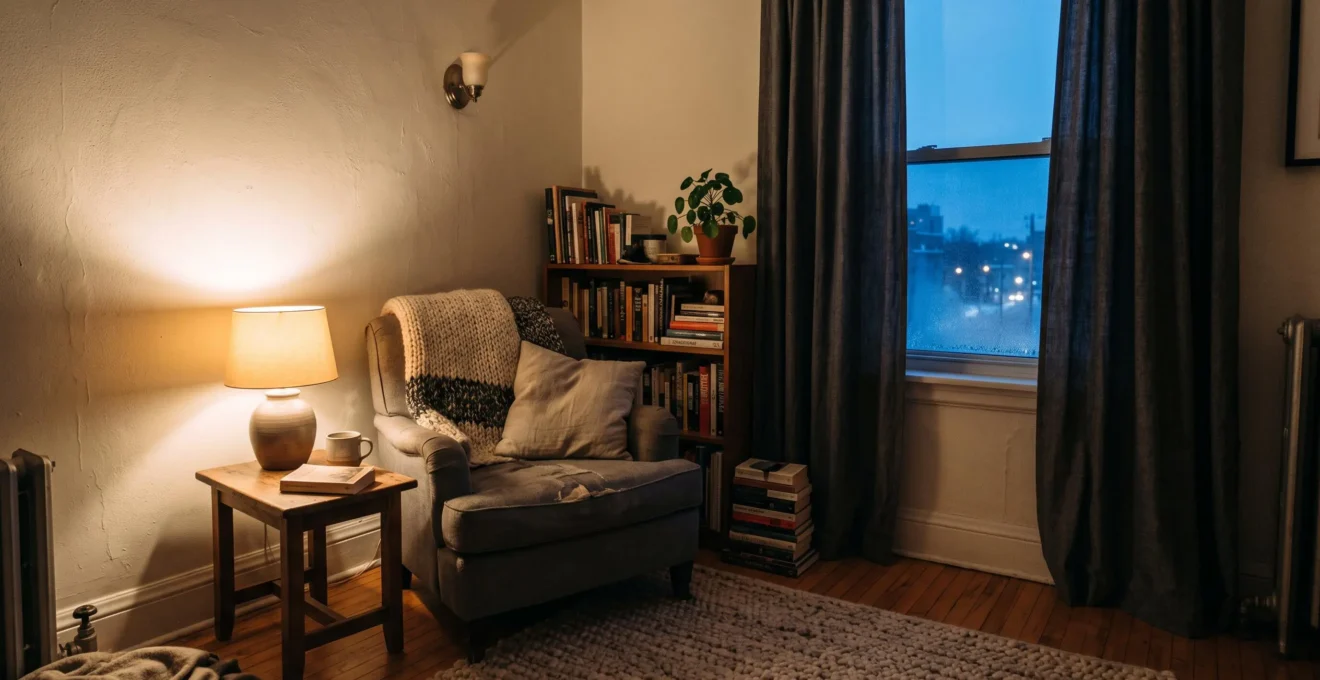
An apartment near a busy avenue, conversations in neighboring units, or a noisy ventilation system can make it hard to unwind. Yet even in a small Canadian urban home, it is possible to set up a pleasant rest area without major renovations.
The solution is to combine several adjustments: choosing a relatively quiet spot, reducing noise, adapting the lighting to the time of day, and maintaining a satisfactory level of thermal comfort. A suitable chair, a few textiles, and some relaxation habits complete the setup.
The goal is not to turn a living room into a soundproofed space, but to create a recognizable area where distractions are reduced. This distinction matters especially in multifunctional apartments, where remote work, leisure, and family life often take place in the same room.
Before buying accessories, observing the sources of discomfort makes it possible to choose simple, gradual measures that are compatible with the constraints of a rental home.
The essentials for creating a soothing rest area
- Choose a spot away from the main sources of noise and heat, then add textiles and reversible acoustic solutions.
- Combine warm, adjustable lighting with a comfortable seat and monitored indoor humidity.
- Pair this environment with a short, repeatable relaxation ritual suited to the occupants’ habits.
- Why does lighting that is too bright get in the way of unwinding before bed?
- How can you reduce outside noise in a reading nook without major renovations?
- Recliner or chaise lounge: which is right for a small living room?
- What problems does overly dry air cause in a heated bedroom in winter?
- Where should you put a relaxation corner to avoid overheating in the afternoon?
- How can you limit video-conference noise in a shared living room?
- How do you do progressive muscle relaxation in ten minutes?
- What relaxation techniques can you practice at home after a demanding day?
Why does lighting that is too bright get in the way of unwinding before bed?
Lighting that is too bright in the evening can keep the body in a state of alertness when it should be gradually preparing for sleep. The intensity, color, and duration of light exposure all influence this transition. In a rest area, warm, indirect, adjustable light sources help create an atmosphere more conducive to relaxation.
Light plays a role in regulating the circadian rhythm, the biological clock that organizes, among other things, the alternation between wakefulness and sleep. Strong light exposure in the evening can disrupt the signals involved in preparing for bedtime, particularly those involving melatonin.
A Canadian study on social media and teen sleep, published in 2024, mentions the blue light from screens among the mechanisms that may affect melatonin. However, this observational study focuses on teenagers and does not directly measure the effect of household light fixtures.
In Canadian cities, the long winter evenings make artificial lighting a constant presence in daily activities. It therefore becomes useful to distinguish between the lighting needed for reading, cooking, or working and the lighting that accompanies the end-of-day wind-down.
Light intensity and color temperature are two different parameters. Cool white light generally contains a larger blue component than warm light. However, color alone does not determine its effect on sleep: the amount of light reaching the eyes, the duration of exposure, and the time of day also matter.
To assess your relaxation corner, simply sit there in the evening and identify the visible light sources:
- General lighting: LED ceiling lights or recessed fixtures that illuminate the entire room.
- Task lighting: a reading lamp aimed at the book rather than at the eyes.
- Indirect lighting: a small lamp or a source reflected off a wall, used to create ambient light.
The ideal is to be able to dim the general lighting while keeping enough light for activities that require good visibility. An adjustable reading lamp and an ambient lamp generally offer more flexibility than a single ceiling light.
However, the opposite extreme should be avoided. An area that is constantly in darkness can become uncomfortable for reading or moving around, particularly for people with specific visual needs.
Once the lighting is under control, noise is often the main remaining obstacle to tranquility.
How can you reduce outside noise in a reading nook without major renovations?
To reduce outside noise without major renovations, you first need to identify where it comes from, then combine absorbent textiles, limited air gaps, and moderate sound masking. Thick curtains, a rug, a full bookcase, and removable seals can improve acoustic comfort, though they do not replace genuine insulation against loud noise.
The noise in an urban apartment comes from various sources: car traffic, conversations in the hallway, neighbors, the elevator, or heating and ventilation equipment. These sounds do not all travel in the same way.
Health Canada, in its recommendations on the effects of noise, points out that unwanted sounds can disrupt sleep and well-being. The agency mentions, among other things, textile surfaces, wall insulation, and white noise as ways to reduce disturbances.
Before buying anything, it is useful to determine whether the noise is continuous, intermittent, high-pitched, or low-pitched. The hum of a ventilation system, voices from a hallway, and traffic-related vibrations do not call for the same solutions.
Three mechanisms help explain the available solutions:
- Sound absorption: rugs, thick curtains, cushions, and suitable panels reduce some sound reflections inside the room.
- Limiting transmission: door seals, door bottoms, and treatments for openings aim to reduce the passage of sound through certain air leaks.
- Sound masking: a quiet fan, nature sounds, or discreet white noise make some intermittent sounds less noticeable.
These approaches have different limits. Textiles mainly improve indoor acoustics and are not a true barrier against the low frequencies of road traffic. Seals can help when sound passes through an opening, but their effect remains limited if vibrations travel mainly through the building’s structure.
Window screens marketed as acoustic should also be evaluated with caution: their effectiveness depends on the product and cannot be assumed without verifiable technical specifications.
In a rented apartment, reversible measures are particularly appealing. A loose rug, a fabric screen, a stable freestanding bookcase, or an acoustic panel that is not permanently fixed can all be moved without major alterations.
Temporary seals or removable sealants can also be considered, provided that the home’s ventilation is respected and that devices needed for safety are never blocked. Drilling, modifying windows, and permanent work may require authorization depending on the lease, the building’s rules, and the province.
White noise is a complementary solution when disturbances are irregular. Its volume should stay low: the aim is to make bothersome sounds less prominent, not to cover them with a second, tiring sound source.
To check the result, listen from the chair, under your usual reading conditions. An audible improvement at the entrance to the living room does not guarantee the same result near the window.
Once the noise becomes less intrusive, the comfort of the seat in turn determines how often the space will be used.
Recliner or chaise lounge: which is right for a small living room?
In a small living room, a recliner is generally more versatile when it also serves for reading or entertaining guests. A chaise lounge is better suited to extended relaxation, but it takes up a large amount of floor space at all times. The best choice depends mainly on the space available in the in-use position, the mechanism, and the living room’s other activities.
A compact chair can look perfectly suited in a showroom, then become bulky once its backrest is reclined or its footrest extended. Conversely, a chaise lounge has a footprint that is often more predictable, but hard to reduce when it is not in use.
Before choosing, consider the actual resting position, not just the dimensions of the piece when closed.
| Criterion | Recliner | Chaise lounge |
|---|---|---|
| Floor footprint | Varies with the degree of recline and the mechanism | Generally large even when not in use |
| Versatility | Can serve as a regular seat for reading or conversation | Mainly suited to a reclined or semi-reclined position |
| Adjustments | Adjustable backrest and sometimes footrest | Backrest sometimes adjustable depending on the model |
| Small shared living room | Appealing if the mechanism allows enough clearance | Suitable if a permanent area can be set aside for it |
Recline mechanisms are a decisive criterion. Some manual recliners tilt backward and require significant clearance behind them. Others have a system that lets them stay closer to the wall. Motorized models sometimes offer additional adjustments, though without guaranteeing a smaller footprint.
It is essential to check the dimensions of the chair when fully extended. Trying it in a store, along with measuring the available space, helps avoid unpleasant surprises.
In a living room that also serves as a home office or play area, a chair with an adjustable backrest and no built-in footrest can be an interesting compromise. A folding chaise lounge is another possibility if its mechanism remains stable and suited to regular use.
Traffic flow around the piece should remain clear, particularly for reaching windows, storage, and exits.
In a Canadian home that is heated for several months, placement also matters. Putting a seat too close to a radiator or a hot-air vent can cause localized discomfort and expose upholstery to excessive heat. The distances and precautions specified by manufacturers should be respected.
Finally, the chair’s fabric influences the feeling of comfort: a breathable fabric that feels pleasant to the touch can be preferable to a covering that retains too much heat during long rest sessions.
Once the furniture is in place, the indoor climate deserves similar attention, particularly when the heating runs daily in winter.
What problems does overly dry air cause in a heated bedroom in winter?
Indoor air that is too dry can worsen a dry throat, nasal irritation, and eye discomfort, particularly during the heating season. It also promotes static electricity. To preserve the comfort of a bedroom or rest area, it is best to measure the actual humidity before adding a humidifier.
In many Canadian regions, winter outdoor air contains little water vapor. Once this air is brought indoors and warmed, its relative humidity can become low, especially when the heating is running at full strength.
This phenomenon does not affect only older houses. It can also appear in newer apartments depending on air exchange, indoor temperature, and the building’s characteristics.
Insufficient humidity can make the airways uncomfortable and contribute to a feeling of dryness during the night. However, nighttime awakenings should not automatically be attributed to this factor alone: noise, temperature, bedding, and other causes may be involved.
The first step is to use a hygrometer. This device measures relative humidity so you do not have to rely on sensations alone. Observing the readings over a few days, particularly in the morning and evening, helps identify variations linked to heating and ventilation.
Three categories of solutions can then be considered:
- Mechanical humidification: a portable humidifier increases the supply of water vapor or fine droplets, depending on its technology. Using one requires appropriate maintenance.
- Passive methods: plants, laundry left to dry, or containers of water can contribute to ambient humidity, but their effects vary and are generally hard to control.
- Correcting indoor conditions: avoiding an unnecessarily high heating temperature and examining the ventilation can sometimes improve comfort without additional equipment.
Health Canada recommends, in its advice on cool mist humidifiers, measuring humidity with a hygrometer and maintaining a value of about 30 % in winter to limit, among other things, the risk of mold. This is not a universal target guaranteeing the comfort of every occupant.
About 30%
Recommended winter relative humidity in Health Canada’s fact sheet on cool mist humidifiers. The value should be assessed in light of the home’s conditions and any signs of condensation.
Health Canada — Cool Mist Humidifiers, fact sheet published in 2016.
Maintaining humidifiers is essential. In a poorly cleaned reservoir, stagnant water can encourage the growth of microorganisms that may be dispersed into the air. You should empty any leftover water, clean the appliance regularly, and follow the manufacturer’s instructions. Health Canada also recommends placing cool mist units in a central location, outside the bedroom, particularly at night.
Conversely, over-humidifying the room can cause condensation on windows and promote mold growth. Traces of water on cold surfaces are a signal to investigate, not an invitation to increase humidity further.
Checking air comfort in five steps
- Install a hygrometer in the rest room and note its location, avoiding the immediate vicinity of a heat source.
- Record the relative humidity in the morning and evening for several days, then keep a table of dated measurements.
- Observe the windows, cold walls, and any sensations of dryness, then make a list of the signs you notice.
- Check the heating setting and the condition of the ventilation, then identify possible adjustments that require no work.
- If a humidifier is needed, set up a written routine for emptying, cleaning, and checking humidity.
The room’s temperature, however, cannot be separated from its humidity: a sun-exposed spot can become uncomfortable even when the air is properly humidified.
Where should you put a relaxation corner to avoid overheating in the afternoon?
To avoid overheating in the afternoon, a relaxation corner should be placed in an area that gets little direct sun at that time. In a Canadian apartment, an east-facing spot may offer more favorable conditions than a west-facing window. You still need to take into account sun protection, insulation, and actual ventilation.
In the Northern Hemisphere, west-facing windows generally receive strong sunlight late in the day. During summer, this exposure can contribute to heat buildup, particularly when large glazed surfaces let solar radiation in.
An east-facing window gets more sun in the morning. This positioning can allow a more pleasant temperature in the afternoon, but the outcome also depends on neighboring buildings, the floor level, materials, and available protections.
A simple way to assess this is to observe the room over several representative days:
- Note when the sun directly reaches the chair or sofa.
- Record the times when the heat becomes uncomfortable.
- Compare the areas near the windows with those farther from the glazed surfaces.
- Identify heat-producing equipment, notably computers and household appliances.
Solutions that require no renovation can then be selected based on your observations. Blinds, suitable blackout curtains, and certain sun protections reduce direct heat gain. Removable solar films can be considered when installing them is compatible with the glazing and allowed in the home.
Health Canada, in its advice on keeping your home cool during extreme heat events, recommends, among other things, closing sun protections during the day and opening windows at night when outdoor conditions and safety allow.
Nighttime ventilation is not an automatic solution, however. When the outside air is still very hot, air quality is poor, or an opening poses a safety risk, other cooling methods should be preferred.
A fan can improve the feeling of comfort under certain conditions, but it does not replace effective cooling during extreme heat. Health Canada notably points out its limits when the temperature exceeds 35 °C. If the home remains dangerously hot, it is better to seek out an air-conditioned or cooler place.
In a rental apartment, moving a piece of furniture or using existing blinds is generally simpler than installing exterior protection. Any change affecting the windows or the facade should be checked with the landlord or the relevant manager.
The best location must balance heat, light, and noise. Moving away from a west window may improve thermal comfort, but moving the chair closer to a noisy party wall is not necessarily progress. You therefore need to choose the compromise that addresses the dominant source of discomfort.
When the rest area shares the room with a workstation, one last constraint appears: preserving the occupants’ peace and quiet during work calls.
How can you limit video-conference noise in a shared living room?
To limit video-conference noise in a shared living room, you need to work toward two goals: improving voice clarity during the call and reducing the conversations audible to other occupants. A headset with a microphone, a good desk layout, a few absorbent materials, and simple rules for living together make up a complementary approach.
In a small apartment, the remote-work station and the relaxation corner can end up just a few meters apart. Work conversations then become a distraction for people who want to read, rest, or do a quiet activity.
The problem works both ways. The remote worker wants to be heard clearly despite household noise, while the other occupants want to avoid being subjected to the conversations. These two needs call for different adjustments.
A three-layer approach helps structure the improvements:
- Station positioning: place the desk at a reasonable distance from the rest area and orient the microphone so that it mainly picks up its user’s voice.
- Local acoustic treatment: use a rug, thick curtains, or suitable panels to reduce certain sound reflections around the workspace.
- Shared organization: agree on time slots for calls, display a discreet signal when a meeting starts, and set aside genuinely quiet periods.
A well-fitted headset often lets you speak at a more natural volume, while also preventing the other participants’ audio from playing through the computer’s speakers. A directional microphone or digital voice processing can also improve transmission quality.
It is important, though, to distinguish between reducing the noise heard by the remote worker and reducing the noise produced in the room. An active noise-canceling headset does not make a conversation inaudible to other occupants. It mainly reduces certain sounds perceived by the person wearing it.
To organize the living room visually, a screen, a stable bookcase, or a fabric divider can help delineate uses. Their acoustic effectiveness depends on their design: a dense plant, for example, is mainly a visual divider and does not replace a true absorbent panel.
When both activities must coexist, reserving the quieter side for rest and positioning the call station near the necessary equipment can avoid frequent moves. In very small homes, alternating schedules can prove more effective than adding furniture.
A test during a real video conference remains useful: someone can sit in the relaxation corner and say whether voices are still too present. This feedback makes it possible to adjust the desk position, speaking volume, and dividers without unnecessary purchases.
When the calls end, that same rest area can become the place for a bodily exercise meant to release the tension built up during the day.
How do you do progressive muscle relaxation in ten minutes?
Progressive muscle relaxation consists of gently tensing different muscle groups, then deliberately releasing them while noticing the difference between tension and relaxation. A ten-minute session can be done in a comfortable chair, working progressively through the body from the feet to the face, without seeking intense contraction or causing pain.
This technique rests on a simple principle: a moderate contraction makes the sensation of release that follows more noticeable. It can suit people who find it hard to slow their thoughts, because attention is first directed to bodily sensations.
Before starting, it is best to settle in a relatively quiet spot, loosen any uncomfortable clothing, and either rest your feet on the floor or support your legs. Your eyes can stay open or closed depending on your preference.
Here is a suggested ten-minute sequence, to be adapted to your comfort:
- Minute 1 — Settling in: adopt a stable position and breathe naturally, without trying to control your breath excessively.
- Minutes 2 and 3 — Feet and legs: lightly tense your feet, release, then repeat with your calves and thighs. Notice the difference between the two sensations.
- Minutes 4 and 5 — Pelvis and abdomen: gently engage the muscles involved, without holding your breath, then let the tension ease.
- Minutes 6 and 7 — Hands, arms, and shoulders: lightly clench your fists, release, then moderately tense your arms and shoulders.
- Minute 8 — Neck and face: relax your jaw and forehead muscles. Avoid any forced tensing of the neck.
- Minutes 9 and 10 — Overall relaxation: mentally scan the different regions of the body and stay for a few moments in a comfortable position.
For each group, a brief, gentle contraction followed by a longer release is enough. There is no need to tense the muscles to the maximum. Discomfort, a cramp, or pain is a sign to stop or adapt the movement.
This approach differs from a slow-breathing or visualization exercise. Breathing acts mainly on respiratory rhythm and attention, while visualization draws on mental imagery. Progressive muscle relaxation directly uses the sensations of tension and release.
On busy days, a condensed version can be limited to the legs, shoulders, hands, and face. It is better to adopt a short, comfortable practice that fits easily into daily life than to impose a session that is too long.
People with an injury, chronic muscle pain, or a condition that could be aggravated by voluntary contractions should seek advice from a health professional before practicing the movements concerned. It remains possible to focus solely on a feeling of relaxation without tensing sensitive areas, if that option is appropriate.
It is not the only technique available, however: choosing a ritual suited to the type of fatigue you feel makes it possible to diversify your recovery moments.
Key takeaways before choosing your relaxation routine
- A rest area becomes more useful when it is paired with a simple, repeatable activity, rather than a constant search for perfect quiet.
- Physical fatigue, mental overload, and noise sensitivity can call for different techniques.
- The quality of the transition between work and rest matters as much as the choice of exercise.
What relaxation techniques can you practice at home after a demanding day?
After a demanding day, several techniques can help restore a sense of calm: muscle relaxation, slow breathing, gentle stretching, reduced sensory stimulation, or mental disconnection. The choice depends on the kind of fatigue you feel. In a noisy apartment, these exercises become easier to practice when they rely on a comfortable space and a regular routine.
Relaxation does not necessarily require a long session. A few minutes are enough to mark a transition between daily obligations and personal activities. The key is to choose an accessible practice, without turning rest into one more task.
Four families of techniques can meet different needs.
- Body-based techniques: progressive muscle relaxation, gentle movements, and comfortable stretches can help you become aware of physical tension.
- Breathing techniques: slow, natural, unforced breathing can support a moment of calm and refocus attention.
- Sensory techniques: dimmed light, a pleasant blanket, a comfortable temperature, and a discreet soundscape help make the place less stimulating.
- Cognitive techniques: setting notifications aside, briefly writing down the concerns of the moment, or devoting time to quiet reading can ease the mental transition.
The choice depends on the situation. After several hours in front of a computer, a few gentle movements or a short walk around the home may be more pleasant than immediate stillness. After a day full of conversations, relative silence and reading may better meet the need for recovery.
Someone preoccupied with the next day’s tasks may prefer to write them down on paper before settling in. The goal is not to solve all of the day’s difficulties, but to keep the moment of rest from becoming another planning session.
The environment built in the previous sections plays a practical role here. Harsh light, an uncomfortable chair, or a work conversation in the background can divert attention and complicate certain exercises.
Conversely, a recognizable space, paired with a soft lamp, a pleasant seat, and a quiet activity, makes the transition easier to repeat.
An end-of-day ritual might, for example, follow three steps: turning off non-essential notifications, changing the living room lighting, then devoting a few minutes to calm breathing or reading. This sequence is a suggested way of organizing things, not a validated therapeutic protocol.
Screens deserve particular attention. Watching a series can be an enjoyable activity, but scrolling through social media or following stimulating content does not necessarily produce the same sense of recovery as a break free of digital demands.
The Canadian research mentioned earlier on social media and teen sleep highlights associations between certain intensive or problematic uses and unfavorable sleep indicators. However, it does not allow us to claim that every screen-based activity prevents relaxation, nor to automatically extend its findings to all adults.
Regularity also matters in how the space is organized. Keeping a book, a blanket, and a lamp within reach avoids having to rearrange the living room before each session. This simplicity encourages spontaneous use of the rest area.
In a family or shared apartment, it can be useful to agree on a relatively quiet time, without trying to impose absolute silence on the other occupants.
To get started, choose a single technique you enjoy, prepare your seat, and give it a few minutes at your next free moment. Then observe what genuinely improves your comfort and gradually adjust the setup, without seeking a perfection that is impossible to maintain.
Can you create a pleasant rest area in a studio with no separate room?
Yes. A compact seat, a small adjustable lamp, and a rug can be enough to visually delineate a space. A screen or a freestanding bookcase can reinforce this separation without creating an actual extra room. The choice of location should above all take into account noise, heat, and traffic flow.
Are thick curtains enough to block traffic noise?
No. They can reduce certain sound reflections and slightly dampen some noises, but their effectiveness against the low frequencies of traffic remains limited. When noise comes through the windows or walls, suitable insulation work may be necessary. Diagnosing the source of the noise helps avoid purchases that are of little use.
Is a humidifier essential in winter in Canada?
No. Its usefulness depends on the home’s actual humidity. A hygrometer can tell you whether the air is in fact dry. An appliance used without monitoring can lead to excessive humidity and promote condensation. Maintaining the reservoir is also essential to limit microbiological risks.
How can you preserve a moment of calm when you share your apartment?
Setting quiet periods, using headphones for audio content, and providing a discreet signal during work calls can reduce interruptions. Visual dividers also help distinguish between uses. The rules should remain compatible with the needs of the other occupants.
Do you need to eliminate all sound completely in order to relax?
No. Some people enjoy a discreet background sound, such as a natural noise or a steady ambience. What matters is to limit sounds perceived as intrusive and to keep the volume comfortable. A masking noise should not become an additional nuisance.