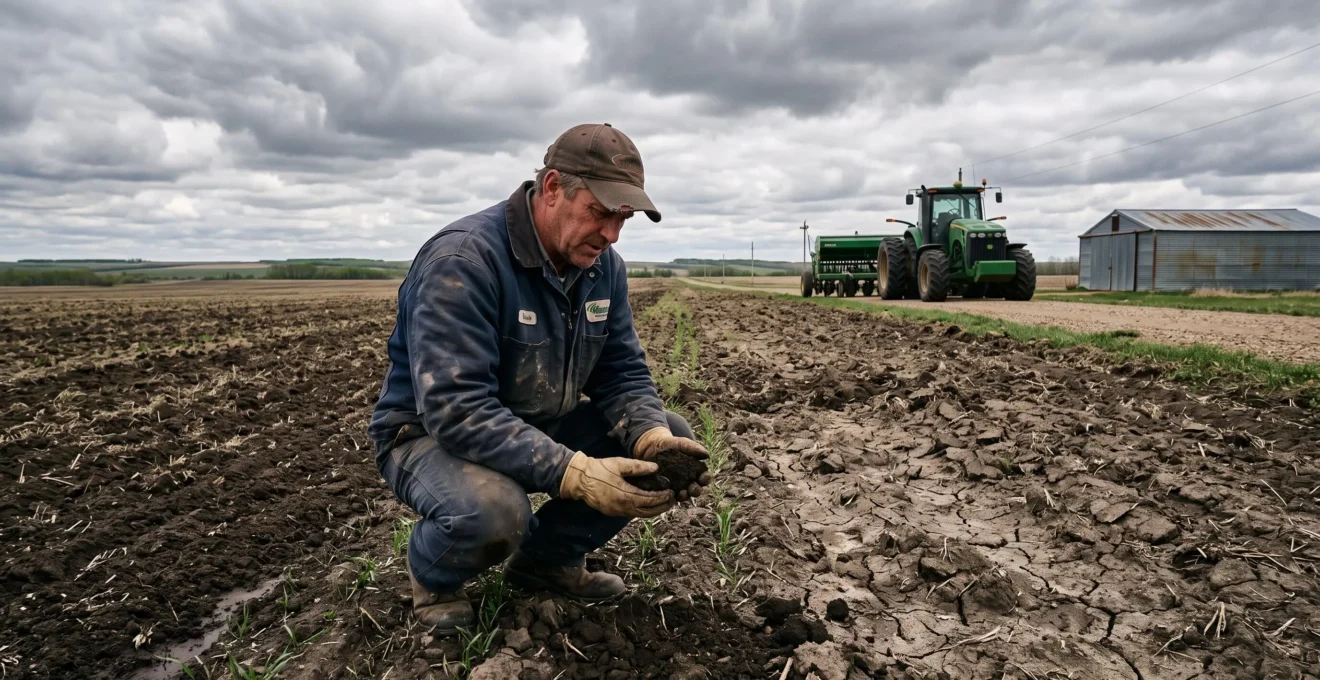
Safeguarding Canadian agricultural resources without compromising harvests requires simultaneously protecting soil structure, fertility, crop cover, and water reserves. In both the Prairies and the market gardening regions of Eastern Canada, practices that support short-term yields can weaken the land when they lead to compaction, erosion, or excessive extraction.
Protecting productive land therefore does not rely solely on input reduction. It requires agronomic decisions adapted to local conditions: organizing machinery traffic, diversifying crops, rationalizing irrigation, analyzing soils, and intervening at the first signs of degradation.
This approach also concerns rural water quality and the economic viability of farms. Sustainable agriculture must enable producers to maintain their production capacity while conserving the resources upon which future harvests depend.
Priorities for protecting Canadian agricultural resources
- Preserve soil structure and cover through controlled machine traffic, diversified rotations, and erosion monitoring.
- Adapt irrigation and fertilization to actual crop needs, available analyses, and climatic constraints.
- Protect water resources and support local producers by combining agronomic prevention with sustainable economic outlets.
- Why does soil compaction reduce yields in the Prairies?
- How to organize crop rotation to limit land depletion?
- Drip irrigation or sprinkler: which method suits vegetable crops?
- What signs reveal concerning erosion on a cultivated plot?
- When to analyze agricultural soils to adjust fertilization?
- What signs should alert owners of a private well?
- When to buy winter-storage produce directly from producers?
- How to take advantage of short food supply chains without increasing your budget?
Why does soil compaction reduce yields in the Prairies?
Compaction reduces soil productivity in the Canadian Prairies because it compresses the spaces between soil particles. Water infiltrates less easily, oxygen circulates poorly, and roots encounter greater resistance. These constraints can limit growth and delay planting, even when fertilizer inputs are sufficient.
Agricultural soil functions through a network of pores of various sizes. The largest facilitate infiltration and aeration, while the smaller ones help retain water available to plants. Under the repeated pressure of agricultural equipment, some of these pores can disappear, particularly when the ground is wet.
According to Agriculture and Agri-Food Canada’s fact sheet on soil texture and water quality, moist clay soils are particularly sensitive to compaction. Heavy or repeated machinery traffic can compromise drainage and germination.
In the Prairies, spring interventions on fields that are still wet after snowmelt therefore represent a high-risk situation. The weight of machinery can densify a surface layer or cause deeper compaction that is difficult to correct naturally.
Less diverse rotations and reduced periods of root cover can also weaken the biological mechanisms that maintain soil structure. However, these factors alone do not prove the origin of a compaction problem: diagnosis must focus on the actual conditions of the plot.
Compacted soil does not necessarily lack fertilizer. Nutrients may be present without being properly utilized because roots cannot effectively cross the densified zone. Systematically increasing fertilization then risks generating additional expenses without resolving the physical constraint.
To identify the problem, a farmer can examine a soil pit and observe root depth. Rooting that suddenly changes direction or spreads horizontally above a dense layer constitutes a useful indicator.
A manual penetrometer also makes it possible to compare penetration resistance according to depth. However, the result depends on soil moisture: measurements taken on very dry soil may give the impression of greater compaction than actually exists.
Prevention relies mainly on limiting unnecessary passes, choosing intervention periods and, where appropriate, traveling along defined traffic lanes. Maintaining plant cover and living roots also helps protect the structure.
Persistent compaction can slow spring drying and push back a crop’s planting date. The yield loss then becomes indirect: it results as much from a disrupted crop calendar as from limited root growth.
Restoring soil structure often takes several seasons. Crop diversification is an essential complement to reducing agricultural traffic.
How to organize crop rotation to limit land depletion?
An effective rotation alternates crops belonging to different botanical families, with distinct nutritional needs, root systems, and pest sensitivities. In Canadian farms, combining cereals, legumes, and cover crops helps diversify nutrient extraction and promote soil structural stability.
Crop succession should be designed as an agronomic system rather than a simple annual alternation. Repeating the same species too frequently can maintain certain disease cycles, concentrate nutrient uptake, and limit the diversity of organic residues.
A rotation can combine different functions:
- Cereals provide residues that contribute to surface cover and organic matter maintenance.
- Legumes, notably peas and certain forage crops, can contribute to nitrogen supply through their association with fixing bacteria, subject to favorable conditions.
- Deep-rooted plants explore other horizons of the soil and diversify the physical effects of roots.
- Cover crops protect the surface between two commercial crops when the length of the season and available moisture allow their establishment.
In the Prairies, water availability is a decisive parameter. Additional plant cover can improve surface protection, but it also consumes moisture. Its value must therefore be evaluated according to precipitation, available water capacity, and the following crop.
Clover and alfalfa can play a dual role. As legumes, they participate in the nitrogen cycle; their root systems also contribute to soil structuring and erosion protection when integrated into a suitable rotation.
Cycle length must take pest pressure into account. A rotation featuring several different crops may remain insufficient if plants sensitive to the same pest return too quickly.
From an economic standpoint, the best succession is not necessarily the one that maximizes the income of each isolated campaign. A temporarily less remunerative crop can be of interest if it improves establishment conditions or reduces certain subsequent input needs.
This possibility must nevertheless be verified: fertilizer savings or future yield gains are not automatic. A relevant comparison looks at the margins of the entire rotation, production costs, climatic risks, and market outlets.
A successful rotation maintains the productive capacities of the land without ignoring the economic needs of the farm. It also helps reduce soil vulnerability to erosion.
Drip irrigation or sprinkler: which method suits vegetable crops?
Drip irrigation is particularly suitable for row vegetable crops and greenhouses when the goal is to supply water directly near the roots. Sprinkling offers greater flexibility for covering large areas or multiple types of crops. The choice depends on climate, water quality, equipment, and extraction constraints.
In Canada, irrigation needs vary greatly depending on regions, soil types, precipitation, and summer temperatures. High-performing equipment in a sheltered market garden is therefore not necessarily the best solution for an outdoor plot exposed to the wind.
The following table compares the two techniques based on operational criteria.
| Criterion | Drip irrigation | Sprinkler |
|---|---|---|
| Water efficiency | Localized supply generally limiting losses outside the root zone | Distribution over a wider area, sensitive to wind and evaporation |
| Initial investment | Piping network, emitters, filtration, and regulation | Pump, piping, and sprinklers adapted to the area |
| Maintenance | Monitoring filters, pressures, and clogging | Checking nozzles, pressures, and distribution uniformity |
| Suitable crops | Row crops, greenhouse production, and localized systems | Market garden beds, low-growing crops, or diversified surfaces |
| Foliage management | Humidification generally limited near roots | Wetting foliage, which can favor certain diseases |
| Winter management | Draining and protection of pipes and frost-sensitive components | Draining and winterization of pumps, pipes, and sprinklers |
Actual efficiency depends more on the setup and management of irrigation than on technology alone. Poorly maintained drip systems can distribute water irregularly. Conversely, a properly sized sprinkler system used in good weather conditions can effectively meet crop needs.
Filtration is particularly important for localized systems. Suspended particles or deposits can clog emitters and cause under-irrigation that is difficult to detect without flow monitoring.
For sprinklers, wind disrupts distribution and can increase water losses. Prolonged wetting of leaves also increases the risk of certain fungal diseases, depending on the cultivated species and weather conditions.
Sprinkling nevertheless has specific uses, notably certain crop cooling strategies during heat events. These interventions require precise management and do not replace the assessment of water needs.
In regions subject to abstraction permits or temporary restrictions, growers must also check applicable provincial requirements. A more water-efficient system can facilitate the management of an authorized volume, without thereby guaranteeing an abstraction right.
Finally, frost is a common constraint. Networks must be designed to allow drainage or appropriate protection before winter.
The goal remains to provide the necessary amount of water at the right time, without causing saturation or unnecessary losses. This control also helps limit runoff and degradation of cultivated lands.
What signs reveal concerning erosion on a cultivated plot?
Concerning erosion manifests notably through rills after rain, a thinned surface horizon, exposed roots, or unusual color differences between zones of a plot. In the Prairies, the displacement of dry soil by wind also constitutes an alert, even when yields have not yet visibly decreased.
The loss of fertile soil is particularly problematic because its natural reconstitution is slow. Fine particles and organic matter can be washed out of the field, progressively reducing the land’s capacity to retain water and nutrients.
Agriculture and Agri-Food Canada’s documentation on field erosion diagnosis describes several observable symptoms: paler coloration, decrease in topsoil thickness, rills, gullies, and drainage problems.
To organize an inspection, observations can be classified according to their apparent severity.
| Observed sign | Possible interpretation | Response to consider |
|---|---|---|
| Surface crust after rain | Structural degradation and limited infiltration | Check soil cover and tillage practices |
| Paler soil on higher ground | Possible decrease in fertile horizon | Compare soil profiles and monitor yields |
| Repeated rills | Concentrated runoff with soil transport | Identify flows and adapt management structures |
| Exposed roots or gullies | Significant localized loss of material | Consider sustainable stabilization of the area |
| Deposits near ditches or hedgerows | Sediment transport from cultivated surfaces | Trace source area and slow flows |
These clues are not always sufficient to quantify degradation. A lighter coloration can also reflect natural soil variation. Diagnosis therefore requires comparing areas with similar initial characteristics.
Wind erosion requires special vigilance on dry, open, and poorly covered lands in the Prairies. Particles moved by wind, soil accumulation behind obstacles, or damage to young plants can signal active phenomena.
On the farm, photographic monitoring from the same observation points helps maintain a visual history. Comparing topsoil thickness with that of a reference area can supplement this monitoring, without constituting by itself a standardized measurement of annual loss.
Checklist: document and limit erosion on a plot
- Walk the field after heavy rain or snowmelt and map areas with rills, deposits, or bare surfaces.
- Photograph several fixed points and record their locations to build an annual monitoring file.
- Examine the soil in an affected area and in a comparable less-exposed zone, then record observed differences.
- Identify practices likely to increase risk, notably periods of bare soil or concentrated flows, and draft a list of corrective measures.
- Schedule an inspection after the next bad weather events to check whether erosion signs persist or worsen, with a dated report.
When damage remains superficial, maintaining residue, cover crops, or adapting tillage can reduce exposure. In the presence of recurrent gullies, grassed waterways, runoff management structures, or local conversion to perennial crops may be necessary after diagnosis.
Prevention generally remains preferable to repairing advanced damage. However, it must rely on precise knowledge of the field, supplemented by analyses when fertility is also at issue.
When to analyze agricultural soils to adjust fertilization?
Autumn, after harvest and before frost, is often a practical period to analyze agricultural soils in Canada. The results can then be integrated into spring fertilization planning. The exact calendar depends nevertheless on targeted parameters, moisture conditions, and laboratory requirements, as certain elements require sampling closer to application.
A soil test provides information on several useful properties, notably pH, available nutrients, and, depending on the chosen analytical program, certain fertility indicators. It does not replace observing structure, biological activity, and crop health.
The primary benefit lies in comparing soil supply with the needs of the planned crop. Automatically repeating the previous season’s fertilizer dose can lead to unsuitable applications if nutrient reserves have evolved.
Sampling must be representative. A zone presenting a very different texture, fertilization history, or productivity generally deserves to be sampled separately rather than mixed with the rest of the plot.
To obtain a usable sample, several cores are taken in each homogeneous zone at a constant depth matching the analytical protocol. After mixing, a representative portion is sent to the laboratory in a suitable container.
The number of cores, depths, and storage methods depend on analyzed parameters and local technical recommendations. Laboratory instructions should be followed rather than using an identical method for all analyses.
Freezing periods, excessive saturation, or sampling immediately after fertilizer application can complicate sampling or make certain results less representative. Date, depth, and fertilization history must therefore be recorded.
A measured concentration does not directly correspond to a fertilizer dose to apply. Recommendations must take into account the crop, target yield, soil properties, organic amendments, and interpretation methods adapted to the region.
Organic matter deserves attention across multiple campaigns. It notably contributes to structure, water retention, and the biological functioning of the land. A punctual variation should not, however, be interpreted as a definite evolution without a comparable sampling method.
In a sustainable fertilization strategy, monitoring therefore combines chemical analyses, field observations, and harvest balances. The objective is to reduce excesses without causing deficiencies likely to penalize yields over the long term.
Better adjusted fertilization protects the farm’s financial resources and limits risks of nutrient transfer to surrounding waters. This issue directly concerns rural properties supplied by private wells.
What signs should alert owners of a private well?
Well water that becomes cloudy, changes color, odor, or taste after heavy rain must be checked. These signs can reveal infiltration or contamination. However, bacteria and certain chemical contaminants can be present without perceptible modification: only adapted analyses can evaluate potability.
In agricultural areas, wells can be exposed to multiple sources of pollution, notably manure applications, certain transfers of fertilizing elements, septic systems, or contaminated runoff water.
Vulnerability depends among other things on well construction, terrain nature, underground flow, and proximity to potential sources of contamination.
Health Canada’s recommendations on testing private well water advocate microbiological testing at least once every six months as well as checks on general water quality parameters every two years. Additional checks are advised after episodes likely to alter water quality.
Every 6 months
Minimum frequency recommended by Health Canada to check for microbiological contamination in private well water. This recommendation does not automatically apply to all chemical analyses.
Health Canada — Well water and health: Testing your well water.
Main warning signals include sudden turbidity, unusual sediment presence, persistent water modification, or test results revealing indicator microorganisms.
Detection of Escherichia coli is particularly concerning. Health Canada indicates that water containing this bacterium is non-potable and requires immediate protection measures. Adopted measures must follow instructions from competent health authorities.
Nitrates represent another challenge. Their concentration can evolve progressively without modifying water appearance. Targeted chemical testing is therefore necessary when local context or previous results justify monitoring.
In case of sudden change or suspicion of contamination, water should not be considered potable until its safety is established. Boiling water can be an indicated measure for certain microbiological risks, but does not eliminate nitrates or other chemical contaminants.
Prevention also involves inspecting the wellhead, its sealing, and the immediate environment. Protection distances and maintenance requirements must be verified with competent provincial or territorial authorities.
Protecting drinking water complements soil conservation efforts. It reminds us that agricultural sustainability concerns both productive lands and the people living nearby.
When to buy winter-storage produce directly from producers?
In Canada, late summer and autumn are generally the most interesting periods to buy foods intended for winter storage directly from producers. Root vegetables, squash, and storage apples are then often available after harvests. Dry goods can be purchased according to local availability, provided appropriate storage is available.
Availability dates vary according to province, latitude, weather conditions, and crops. A Quebec farm, an Ontario operation, and a Prairie producer do not necessarily offer the same products at the same time.
An indicative calendar can guide purchases, without replacing consultation with local producers.
| Products | Generally advantageous purchase period | Points of vigilance |
|---|---|---|
| Potatoes, carrots, beets | Late summer and autumn | Choose healthy products suitable for storage |
| Winter squash | Autumn | Check maturity, skin integrity, and stem condition |
| Storage apples | Autumn | Favor storage varieties and avoid bruised fruit |
| Grains and dry legumes | After harvest or according to marketed stocks | Check product dryness, packaging, and storage conditions |
Success depends as much on storage as on the purchase price. Vegetables bought in large quantities can become a bad deal if home conditions promote their rapid deterioration.
Not all products have the same needs. Apples prefer a suitable refrigerated environment, while garlic requires a cool, dry, and ventilated location. Carrots and beets store better after removing their tops.
Canada’s Food Guide recommends adapting storage conditions to each category of fruits and vegetables to reduce waste. Freezing also offers a solution to extend the use of certain foods bought in season.
Direct purchases can take several forms: bulk farm orders, winter baskets, farmers’ markets, or collective buying. Each formula offers a different balance between price, flexibility, transport, and variety.
A household with a cool cellar or a suitable refrigerated space can store certain products more easily than a household living in a heated home without a proper storage area.
Before placing a large order, it is therefore useful to estimate the quantities actually consumed and to verify storage possibilities. An attractive unit price does not offset discarded food, disproportionate travel, or purchases exceeding actual needs.
By buying the right quantities at the right time, consumers can better manage their expenses while supporting regional agricultural production. This logic aligns more broadly with that of short food supply chains.
Key takeaways before prioritizing short food supply chains
- Compare prices based on equivalent quality and actual consumable quantity, rather than assuming that direct selling is systematically cheaper.
- Adapt purchases to the season, storage capacities, and household needs to prevent food loss from canceling out savings.
- Prioritize regular and economically viable commercial relationships with producers, without overlooking transportation and organization costs.
How to take advantage of short food supply chains without increasing your budget?
Taking advantage of short supply chains without spending more consists of primarily buying seasonal produce, comparing prices for equivalent quality, and organizing purchases around actual household needs. Bulk orders, tailored baskets, and waste reduction can offset certain price differences while supporting local producers.
A short supply chain is generally characterized by a limited number of intermediaries between the producer and the consumer. It can take the form of farm sales, a farmers’ market, community-supported agriculture baskets, or direct orders.
Fewer intermediaries does not automatically mean a lower price. Direct sales may allow the producer to retain a larger share of the commercial value, but it also involves costs related to distribution, packaging, sales time, or order preparation.
The comparison should therefore focus on truly comparable products: same variety when possible, equivalent freshness, useful quantity, and sought-after quality.
Minimally processed seasonal vegetables can be good categories to examine, but no systematic price advantage can be assumed. Prices depend on farms, volumes, and local market outlets.
Several methods help organize purchases without unbalancing the budget:
- Plan meals around available produce to limit unplanned supplementary purchases.
- Compare food prices per kilogram or per actually consumable unit, taking quality differences into account.
- Organize collective orders when producers offer suitable volumes and travel costs remain reasonable.
- Choose seasonal baskets compatible with household composition rather than accepting quantities impossible to use.
- Plan to process or freeze surpluses when food safety conditions allow.
In Quebec, some farms offer community-supported agriculture arrangements, often called farm baskets. They rely on a regular commitment between consumers and producers. Their economic interest depends on content, timing, payment terms, and the household’s ability to use the delivered produce.
To illustrate the trade-off, a hypothetical scenario can be constructed from an existing food budget.
Hypothetical practical case: organizing purchases from a farm
A household wishes to replace a portion of its supermarket vegetable purchases with a weekly order from a local producer. It begins by tracking the cost and quantities actually consumed over several weeks.
It then compares a farm basket of known composition with its usual basket, factoring in travel, potential waste, and supplementary products. If total spending remains higher, it reduces the volume or limits direct purchases to categories presenting the best ratio between quality, price, and actual use.
This method avoids judging short supply chains solely on the listed price. It takes into account freshness, purchase frequency, potential transport savings, and the quantity of food actually consumed.
Supporting local producers can also help maintain market outlets for regional agricultural operations. A more predictable income can facilitate their economic planning, without by itself guaranteeing the adoption of resource conservation practices.
To concretely support the protection of agricultural land, consumers can also learn about the soil, water, and crop management practices implemented by the farms from which they buy.
An initial step is to compare routine food purchases with the seasonal offerings of a few accessible producers, then test an order adapted to the household’s actual budget. This gradual approach can support local agriculture without imposing a lasting extra cost.
Can agricultural yields be maintained while reducing soil degradation?
Yes, yield preservation and soil protection can be compatible when practices are adapted to farm constraints. Limiting compaction, improving rotations, preserving plant cover, and adjusting nutrient inputs address several causes of degradation. Results depend, however, on climate, crops, and initial soil condition.
Which Canadian agricultural soils require special vigilance against compaction?
Clay soils, particularly when wet, show high sensitivity to compaction from repeated machinery traffic. Risk also depends on equipment load, pass frequency, and moisture levels during operations. Field observations remain essential to establish a diagnosis.
Is reduced tillage sufficient to prevent erosion?
No. Reduced tillage can help preserve protective surface residue, but its effectiveness depends on actual cover, slope, drainage, and weather events. Certain plots also require vegetative buffer strips, modified rotations, or structures against concentrated runoff.
How can you tell if a farm is using its water resources efficiently?
Evaluation relies on crop water needs, extracted water volume, application uniformity, losses, and soil moisture. Flow checks, equipment maintenance, and weather monitoring help detect waste. Abstraction obligations must also be verified with the competent authority.
How can agricultural land protection be reconciled with economic profitability?
Comparison should cover multiple seasons rather than a single year’s expenses. Costs for crops, fertilization, mechanization, and water management can be balanced against margins, climatic risks, and productivity trends. This approach helps select protective practices that remain economically sustainable.