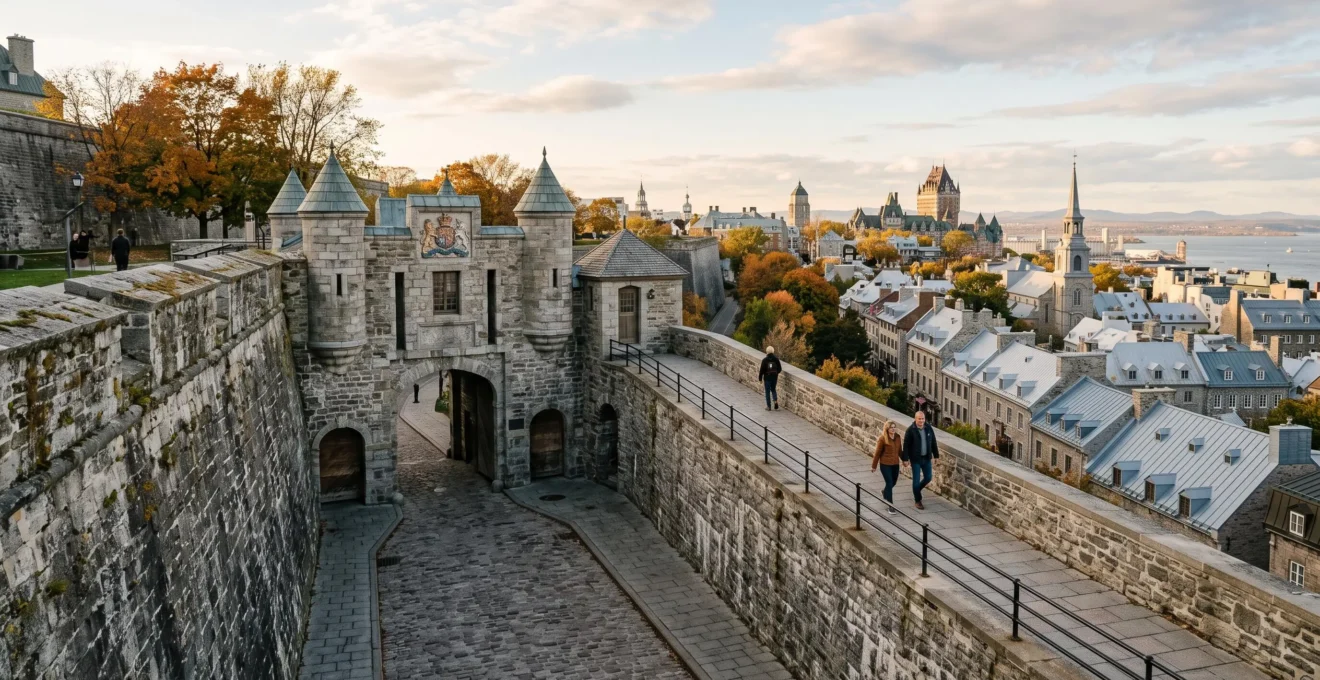
Canada’s historic monuments tell the story of several centuries of cultural exchange, colonization, military conflict, and economic change. From the ramparts of Quebec City to the fortifications of Nova Scotia, they make it possible to understand how different communities shaped the land and preserved traces of their past.
To explore this heritage, the major monuments are accessible starting points. The fortifications of Old Quebec illustrate military and urban history, the remains of Old Montreal reveal the transformations of a commercial city, while Louisbourg brings part of New France back to life through a documented reconstruction.
But a historical discovery is not limited to buildings. Craft workshops, regional traditions, and cultural experiences offered by local communities give access to other dimensions of Canadian heritage. The choice therefore depends as much on the historical period you are looking for as on the level of immersion you want, the season, and the time available.
The essentials for discovering Canadian historical heritage
- To explore fortifications and historic urban ensembles, favor Quebec City, Montreal, and the major military sites of Nova Scotia.
- To understand the difference between authentic remains and reconstructions, compare in particular the Halifax Citadel and the Fortress of Louisbourg.
- To discover living heritage, complement monumental visits with craft workshops, économusées, or cultural activities offered locally.
- Why do the fortifications of Quebec City hold a special place in Canada?
- How do you visit the historic sites of Old Montreal in one day?
- Fortress of Louisbourg or Halifax Citadel: which site should you discover?
- How can you tell an authentic historic building from a reconstruction?
- When should you visit outdoor historic sites before seasonal closures?
- Why do historic workshops make it easier to discover regional heritage?
- Économusée or independent workshop: which visit should you choose to discover a trade?
- What immersive activities let you discover local culture in Canada?
Why do the fortifications of Quebec City hold a special place in Canada?
The fortifications of Quebec City form an exceptional defensive ensemble in North America. The city preserves ramparts, gates, and bastions that bear witness to its French and then British military past. Their importance goes beyond architecture: they make it possible to understand the evolution of Quebec City as a colonial capital, a strategic stronghold, and an internationally recognized heritage city.
Founded by Samuel de Champlain in 1608, Quebec City occupies a strategic position on the St. Lawrence River. Its defensive works evolved with colonial rivalries and changes in military techniques. The fortifications visible today thus bear the marks of different periods of construction, modification, and conservation.
According to the Old Quebec entry on the World Heritage list of UNESCO, the city preserves a particularly complete fortified ensemble north of Mexico. The listing, however, covers the entire historic district, including the fortified Upper Town and the Lower Town, and not the ramparts alone.
The conservation of the fortifications also reflects an evolution in how heritage is viewed. In the 19th century, the old military walls could appear as obstacles to traffic and urban expansion. In Quebec City, preservation and redevelopment work helped keep them in place, notably in the context of the city’s historical promotion.
To understand these works, a walk following their course is more instructive than a series of panoramic photographs. The Saint-Louis Gate allows you to look at the access points to the Upper Town and the transformations of the enclosure. The Saint-Jean Gate also shows how the passages between the old city and the surrounding neighborhoods were adapted to modern traffic.
The Kent Gate completes this reading, while the bastions and the areas near the Citadelle reveal the military logic of the whole. It is worth distinguishing today’s gates from the works that preceded them: their appearance does not necessarily match that of the 18th century.
The British conquest of 1759, the military reorganization after 1760, and later American threats make it possible to place the fortifications in context. Each stage of the walk can thus be linked to a political or defensive transformation, without assuming that all the visible works already existed during the same events.
A large part of the public spaces around the fortifications can be explored freely. On the other hand, access to certain buildings, military areas, or interpretation spaces may depend on tickets, schedules, and organized tours. In winter, snow and ice can also limit certain passages.
This approach makes it possible to understand why Old Quebec is more than an architectural backdrop: it preserves the memory of several successive military, political, and urban functions.
How do you visit the historic sites of Old Montreal in one day?
To discover Old Montreal in one day, it is better to organize the visit around the major periods of its history: the colonial origins, the religious and administrative development, then the commercial and port boom. A walking route combining Pointe-à-Callière, Saint-Paul Street, Notre-Dame Basilica, and the former civic buildings makes it possible to build this chronological reading.
The day can begin at Pointe-à-Callière, near Place Royale, in the area associated with the origins of Montreal. The museum lets you explore the history of the territory, the successive occupations, and the founding of Ville-Marie in 1642. Place Royale here is a Montreal historical landmark, not to be confused with Place Royale in Quebec City.
The archaeological research of Pointe-à-Callière documents several layers of occupation: the Ville-Marie fort, the Callière estate, and later commercial activities. Excavations have notably made it possible to find the location of the fort and traces of its buildings.
This archaeological depth gives the walk another dimension. Old Montreal is not limited to its visible façades: some of today’s buildings are layered over much older remains and structures.
The route can then continue to Saint-Paul Street and the area of the Old Sulpician Seminary, whose architecture recalls the religious institutions of the French period. Place d’Armes and Notre-Dame Basilica let you continue the visit while distinguishing the age of the neighborhood from that of its present buildings. The basilica visible today dates from the 19th century: it should not be presented as a building preserved from New France.
The afternoon can be devoted to the Château Ramezay, Place Jacques-Cartier, and the Old Port areas. This group of sites lets you explore colonial powers, the evolution of the city, and its economic development. The former wharves and commercial buildings invite you to observe the role of the river in trade.
For a single day, a selection of indoor visits remains necessary. Squares, streets, and many façades can be seen without a ticket, whereas museums and certain heritage buildings have their own hours and admission conditions.
Preparing a heritage day in Old Montreal
- Choose three major historical periods to explore and write them into a mini chronological program.
- Locate the corresponding monuments and museums on a map to get a coherent walking route.
- Check the opening hours of indoor visits and keep a list of the available time slots.
- Book the priority sites when necessary and save the confirmations.
- Plan an indoor alternative in case of cold or rain, with a verified address and schedule.
Between January and March, winter conditions make indoor breaks particularly important. Some establishments may change their hours depending on the season. A balanced route therefore includes fewer in-depth visits, but leaves more time for observation.
This method helps you read the city as a living historical ensemble, before discovering the more spectacular military fortifications of Nova Scotia.
Fortress of Louisbourg or Halifax Citadel: which site should you discover?
The Fortress of Louisbourg is particularly suited to travelers looking for an immersion in 18th-century French colonial life. The Halifax Citadel better answers the desire to discover a 19th-century military fortification in the heart of a city. The choice therefore depends on the period you are looking for, the time available, and your interest in historical reconstructions.
Located on Cape Breton Island, in Nova Scotia, Louisbourg offers a partially reconstructed fortified urban ensemble. The buildings, streets, and interpretation spaces let you imagine the organization of a French port city in the colonial era. When seasonal programs are offered, costumed interpreters and demonstrations give this discovery a concrete dimension.
Reconstruction is a fundamental characteristic of the site, not a secondary element. The program launched in 1961 aimed to recreate approximately a quarter of the town and its fortifications, mainly in their configuration of the 1740s. Many of the visible buildings incorporate old foundations, but most of the elevations were rebuilt in the 20th century.
The Halifax Citadel offers a different experience. Its current fortification dates from the 19th century and overlooks the city center. It lets you explore the principles of a star-shaped defense, the workings of a garrison, and British military history in Canada, in a site that also keeps a contemporary military function.
The differences between the two destinations appear more clearly when you compare visit goals and travel constraints.
| Criterion | Fortress of Louisbourg | Halifax Citadel |
|---|---|---|
| Dominant period | 18th-century New France | 19th-century British fortification |
| Nature of the heritage | Documented partial reconstruction on a historic site | Preserved historic fortification, modified and still in use |
| Experience sought | Immersion in a colonial town | Military and architectural discovery |
| Organization | Dedicated trip to Cape Breton Island | Visit that can be built into a stay in Halifax |
| Time to allow | Several hours for an in-depth visit | A few hours, depending on the activities available |
| Seasonality | Immersive programming particularly tied to the tourist season | Site open year-round with varying services |
For a family wanting to discover the trades, gestures, and scenes of daily life in New France, Louisbourg can offer a particularly telling experience when the animations are running. For a traveler with half a day in Halifax, the Citadel is a simpler solution to fit into an urban program.
The two sites can also be complementary: one helps you understand a French colonial society recreated from historical research, the other presents preserved military architecture and its successive uses.
This comparison raises an essential question for any heritage trip: how do you recognize what truly belongs to the era being studied and what has been rebuilt to make it understandable?
How can you tell an authentic historic building from a reconstruction?
To tell an old building from a reconstruction, you need to identify the surviving physical elements, the restorations carried out, and the rebuilt parts. Appearance is not enough: a recent building can faithfully reproduce old techniques, while an authentic building may have undergone many transformations. Archives, archaeological studies, and conservation notices remain the most reliable reference points.
A first examination looks at materials. Old masonry may show signs of repairs, variations in the stone bonding, or changes in the mortar joints. Beams, foundations, and openings are also clues. However, patina or wear alone does not allow you to date a construction with certainty.
Successive transformations are sometimes more instructive than the supposed original state. An enlarged window, an added wing, or a modified façade tell the story of the building’s adaptation to new uses. A heritage building does not necessarily represent a single era: it can preserve several historical layers.
Conversely, a reconstruction aims to make a vanished architecture legible. At Louisbourg, documentary and archaeological research was used to rebuild part of the French town. The presentation of the reconstructed site of Louisbourg by Parks Canada specifies that almost all the visible buildings are reconstructions from the 1960s to the 1980s, although several incorporate original foundations.
Louisbourg: a reconstruction based on historical research
In 1961, the Canadian government launched a reconstruction program intended to recreate approximately a quarter of the French colonial town and its fortifications, relying on the remains and historical knowledge available.
The result today lets visitors walk through part of the urban layout of the 1740s. It is not, however, a set of fully preserved 18th-century buildings: the site combines original traces with constructions contemporary with their interpretation.
Heritage designations should also be read carefully. In Canada, federal, provincial, and municipal designations do not all describe the same reality. A place may be recognized for its architecture, its association with a personality, its role in an event, or its historical importance. A designation therefore does not imply that all the materials are original.
Historic villages sometimes take mixed approaches. Old buildings may have been moved from their original location, restored, or combined with recreated constructions. Visitors should distinguish the authenticity of the materials, that of the location, and that of the historical presentation.
Before interpreting a building, three questions help clarify its status: which part is original, what work has been done, and what evidence underpins the restitution? A posted chronology, a heritage inventory, or an archaeological report generally allows you to go beyond visual impression.
The value of a visit does not depend solely on the proportion of original materials, but also on the transparency with which the place explains its history and its interventions.
When should you visit outdoor historic sites before seasonal closures?
The most favorable period for visiting outdoor Canadian historic sites depends on the site and its region. Late summer and early fall can offer a good compromise between comfort and crowds, but not all interpretation programs stay active until the same dates. Access, hours, and activities must be checked separately.
Canadian heritage sites experience very different seasonal conditions. Urban fortifications, museums housed in buildings, and open-air historic villages do not necessarily have the same calendars. Permanent access to the grounds does not mean that the rooms, guided tours, and demonstrations are available year-round.
The Halifax Citadel illustrates this distinction. According to the official hours of the Halifax Citadel, the site and its grounds remain accessible throughout the year, but the range of services varies with the season.
For the program published for 2026-2027, the main period runs from May 7 to November 5, 2026, with daily opening from 9 a.m. to 5 p.m. From November 6, 2026, to May 6, 2027, winter hours apply, while the indoor rooms, exhibits, and the upper level of the ramparts become inaccessible to the public under normal conditions. Some special tours may remain possible by reservation.
This information concerns only the Halifax Citadel. It should not be applied to Louisbourg, the ramparts of Quebec City, or all the sites administered by Parks Canada.
May 7 – November 5, 2026
Main programming period announced for the Halifax Citadel. The site remains open outside this period, but with a reduced offering.
Parks Canada, official calendar of the Halifax Citadel for 2026-2027.
For a historical reenactment site, the presence of interpreters and demonstrations can determine the very appeal of the visit. A fortress that is open without animation does not necessarily offer the same experience as in peak season. You should therefore check the activities actually maintained on the date you have in mind.
Weather conditions also play an important role. Rain, sea winds, snow, and frost can change movement, visibility, and comfort on the outdoor works. In some regions, mosquitoes can also affect the summer experience.
To plan a visit, it is useful to cross-check three elements: the availability of the activities you want, local climate conditions, and indoor fallback options. A less crowded date is only an advantage if the essential elements of the experience remain accessible.
This preparation avoids discovering on site that a heritage complex can be seen only from the outside, and lets you devote more time to the visits that are truly open.
Why do historic workshops make it easier to discover regional heritage?
Historic workshops make regional heritage more concrete by showing how inhabitants produced, repaired, and exchanged the objects needed for their daily lives. Woodworking, weaving, blacksmithing, or traditional food techniques let you discover the economic history of a community through gestures, tools, and materials.
Major monuments often bear witness to political, religious, or military power. Workshops give access to a complementary history: that of the trades and the people whose work kept villages and cities running.
In a heritage carpentry workshop, for example, observing manual work helps you understand the properties of wood, the usefulness of tools, and the constraints of making things. A weaving demonstration can reveal the time and skills required to produce textiles. These experiences give a material meaning to activities that museum display cases do not always let you fully grasp.
This transmission also concerns intangible heritage. Techniques, practical knowledge, and know-how can be passed between generations even when the original buildings have disappeared. It remains essential, however, to distinguish a recreated historical practice from a trade still practiced today.
A particularly interesting discovery is to visit several complementary workshops in the same region. The miller, the baker, the blacksmith, and the carpenter, for example, let you explore different stages of a local economy based on the transformation of resources and exchanges between trades.
Such a circuit must be adapted to the real history of the territory: not all these trades had the same importance or the same forms of organization everywhere. The explanations offered by artisans, regional museums, and local archives make it possible to place each practice in its context.
Many heritage workshops are found in rural localities or less-visited historic centers. Discovering them may require a specific trip and prior verification of opening hours. This constraint becomes an advantage for travelers who want to meet practitioners and explore lesser-known heritage.
Craft heritage thus complements monuments by giving a place to the techniques and communities that contributed to the evolution of the Canadian territory.
Économusée or independent workshop: which visit should you choose to discover a trade?
An économusée suits visitors looking for a structured educational discovery of a craft, while an independent workshop can offer a more personal encounter with an artisan. Neither format is automatically more authentic. The best choice depends on the place given to real production, historical explanations, and public participation.
The économusée concept is based on opening craft or agri-food businesses to the public. The production activity is accompanied by an interpretation approach: presentation of a trade, discovery of techniques, historical context, and, depending on the establishment, display of objects or sale of products.
This framework makes it easier to understand for travelers who are unfamiliar with the trade presented. Visitors can discover the raw materials, the stages of production, and technical developments without any prior knowledge.
An independent workshop operates more freely. Some artisans offer demonstrations, hands-on classes, or meetings by appointment. Others devote themselves above all to making things and do not have a space suited to welcoming tourists.
To choose, you need to compare the precise form of the visit rather than relying solely on its label.
| Criterion | Économusée | Independent workshop |
|---|---|---|
| Presentation of the trade | Structured interpretation route | Content varies depending on the artisan |
| Real production | Craft business in operation | Often at the heart of the encounter |
| Participation | Depending on the activities offered | Sometimes possible in a small group or by reservation |
| Organization | Visit information generally formalized | Prior contact sometimes essential |
| Main appeal | Understanding a trade in an educational setting | Talking directly about a specific practice |
The économusée is not just an exhibition, any more than the independent workshop guarantees constant interaction with the artisan. Production may be interrupted on the day of the visit, a demonstration may require a reservation, and some areas may remain inaccessible for safety reasons.
Before traveling, it is therefore best to ask whether the activity includes a demonstration, a historical explanation, hands-on participation, or simply access to a presentation space. The length and the language of the welcome can also influence the choice.
For a first contact with several regional crafts, the framework of a network of économusées can make it easier to build a route. To go deeper into a specific technique, an organized meeting with an independent artisan can be particularly rewarding.
Beyond trades, these visits open onto a broader discovery of local cultures: community events, culinary traditions, music, and experiences organized by residents.
Key takeaways for extending your discovery of Canadian heritage
- A monument visit explains a historical context; a participatory activity lets you explore the practices and people who carry that heritage forward.
- The quality of a cultural experience depends on its content, its facilitators, and its real connection with the community concerned.
- Combining a historic site with a consistent local activity lets you discover several dimensions of the same region without needlessly multiplying trips.
What immersive activities let you discover local culture in Canada?
The most relevant immersive activities for discovering local culture in Canada include skills workshops, animated visits, meetings with artisans, community events, and experiences offered by Indigenous tourism businesses. Their value depends on the degree of participation and the quality of the cultural transmission, rather than on how spectacular the activity is.
A first form of immersion rests on guided observation. Guided historical tours, trade demonstrations, or costumed interpretations let you understand a cultural environment without necessarily taking part in its practice. This approach is particularly suited to travelers with little time or looking for a structured introduction.
The second level is guided interaction. Taking part in a craft workshop, learning a making technique, or talking with a person who practices a traditional trade allows you to deepen your understanding. The activity makes more sense when the facilitator explains the origin of the techniques, their evolution, and their current place in the community.
A longer immersion can finally take the form of a cultural stay, participation in a regional festival, or an experience organized around local traditions. It requires more time and sometimes a prior reservation, but it lets you go beyond a mere succession of tourist sites.
Indigenous cultural experiences hold an essential place in this discovery. Businesses and organizations led by members of First Nations, Inuit, and Métis communities offer activities that let you explore their histories, know-how, and contemporary cultures from their own perspectives.
For these experiences, it is important to favor those designed, led, or explicitly authorized by the communities concerned. Not all cultural knowledge and practices are meant to be presented to the public. A respectful activity clearly states its framework and the terms of participation.
Immersive activities can also complement the major monuments. After a visit to Louisbourg, an experience devoted to a regional know-how can extend your understanding of the economy and daily life. In Halifax, a historical discovery can be followed by an activity devoted to musical traditions or local cultural history, when suitable events are scheduled.
To select a quality experience, several criteria deserve attention: the identity of the facilitators, the accuracy of the cultural content, the opportunities for exchange, the size of the group, and the distinction between living practices and historical reenactments. Participants’ reviews are more useful when they describe what they actually learned than when they only rate the welcome or the setting.
A highly staged experience is not necessarily without value. It must, however, clearly explain what is interpretation, reenactment, or contemporary practice. This transparency avoids reducing local cultures to fixed representations of the past.
The next step is to select, in the same region, an activity led by people who know and practice the traditions being presented. An itinerary combining built heritage, know-how, and local encounters thus lets you explore Canadian history in all its diversity.
Do you need to book visits to historic monuments in Canada?
Booking depends on the monument and the type of visit. Walks through historic streets and public spaces are often freely accessible, while certain museums, guided tours, and workshops require a ticket or a specific time slot. It is best to check the operator’s conditions before traveling.
Can you discover Canadian historic monuments in winter?
Yes, but the arrangements vary greatly. Some urban monuments remain visible year-round and several museums offer indoor visits. Other sites reduce their animations or temporarily close certain facilities. The winter restrictions at the Halifax Citadel illustrate the difference between a place that is open and services that are fully available.
Does a historical reconstruction have real heritage value?
Yes, when it makes it possible to understand a vanished place based on documented historical and archaeological research. Louisbourg is one example. A reconstruction should not, however, be confused with a building entirely preserved since its original era: the two convey different heritage information.
How can you find lesser-known heritage visits in Canada?
Regional museums, provincial heritage directories, networks of économusées, and local tourism organizations are useful starting points. Looking for workshops, historic villages, and sites linked to regional economic activities often leads to places that complement the major monuments.
How do you choose a respectful Indigenous cultural experience?
You should favor activities designed or led by the Indigenous communities concerned, notably Indigenous tourism businesses that clearly present their facilitators and their goals. Checking the terms of participation, respecting restrictions on photography, and not assuming that all cultural practices are open to visitors are also essential.