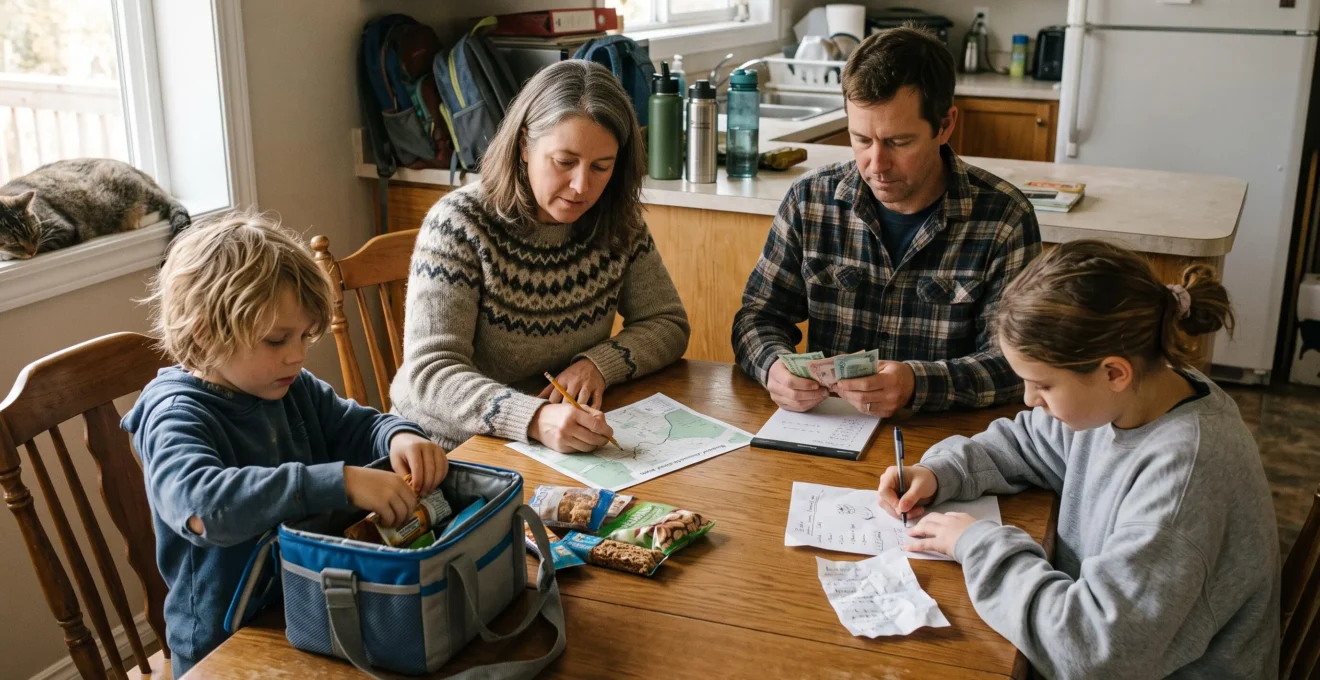
A treasure hunt in a municipal park, a picnic prepared together, or a walk turned into an exploration mission can become precious family memories, with no costly tickets or big trip. What matters is creating an experience that everyone takes part in, with enough time to enjoy it.
In Canada, the possibilities change with the seasons: accessible trails in summer, libraries and museums when the weather turns, neighborhood festivals, winter activities, or local cultural discoveries. The secret is to choose an outing suited to the children’s ages, the available budget, and the family’s energy.
Rather than multiplying destinations, it is sometimes better to prepare a single special outing, let the children make a few decisions, and extend the enjoyment once you are back home. With simple organization, an ordinary activity can become a family tradition that everyone looks forward to repeating.
Creating family memories without spending too much: the essentials
- Involve the children in choosing and preparing activities to give them a role in the experience.
- Favor municipal parks, community activities, and outings close to home to limit transportation and admission costs.
- Extend shared moments with a conversation, a drawing, or a memory notebook made together.
- Why do activities prepared together leave a stronger mark on children?
- How do you prepare a family treasure hunt in a municipal park?
- Day trip or weekend: which format should you favor with young children?
- What mistakes should you avoid when organizing a special day with several children?
- How do you make a family travel journal after a getaway in Quebec?
- Recreational cycling or trail walking: which activity should you favor as a family?
- Interactive museum or theatrical tour: which experience should you choose as a family?
- What immersive activities let you discover local culture in Canada?
Why do activities prepared together leave a stronger mark on children?
Preparing an activity as a family gives children the chance to take part in decisions, look forward to the fun, and feel involved in a shared project. Choosing a route, preparing snacks, or inventing a game makes the experience more personal. This participation can enrich the shared moment, even though it does not, by itself, guarantee a longer-lasting memory.
Imagine an outing to a park a few kilometers from home. If the adults decide everything, the children simply discover the activity at the moment of departure. By inviting them to pick the snack, draw a route, or prepare a challenge, the outing becomes their project too.
Dividing roles by age lets everyone take part without complicating the organization:
- Ages 3 to 5: choose between two destinations, pick a snack, or decorate the outing bag.
- Ages 6 to 9: prepare an equipment list, invent clues, or help spot the stages of the route.
- Age 10 and up: compare several activities, help set the budget, or suggest a reasonable itinerary.
It is also worthwhile to photograph the behind-the-scenes: the picnic preparations, the drawings made before leaving, or the discussions around a map. These traces tell part of the experience that photos taken at the destination do not show.
How you talk about the activity afterward matters too. A study published in Child Development on children’s autobiographical memories showed that more elaborate parent-child conversations about past events could promote the richness of the memories told by young children. It does not, however, demonstrate that preparing an outing directly improves memory.
What research shows about young children’s memories
In a study published in 2007, Elaine Reese and Rhiannon Newcombe examined the effects of training given to mothers to enrich their conversations with their children about past events.
The children in the group concerned told richer memories during the assessments. The result supports the value of conversations after an activity, but is not proof that a free outing is better remembered than a paid one.
On the way back, a very simple ritual is enough: ask everyone which moment surprised them, made them laugh, or made them proud. The youngest can answer with a drawing. The important thing is to let each child tell their own version.
Once this participation is established, an activity as accessible as a treasure hunt in a park becomes an excellent testing ground.
How do you prepare a family treasure hunt in a municipal park?
To organize a family treasure hunt in a municipal park, choose a short, safe route, prepare five to eight clues based on visible features of the place, and adapt the challenges to the children’s ages. A few sheets of paper and a pencil are enough. The goal is to explore together, with no purchases or complicated setup.
Start by scouting a park close to home. Check the access points, restrooms, water points, trails, and the spaces where the children can stop. A loop route generally makes it easier to return to the starting point.
Also plan a backup if the chosen picnic area is occupied or reserved for another group.
To create the clues, use landmarks the children can observe without moving objects or leaving permitted areas. For example: find a tree whose leaves have a particular shape, count the benches along a path, or recognize an animal drawn on a sign.
For the youngest, favor pictures or observation challenges. Older children can solve riddles, follow a hand-drawn map, or decipher a simple message.
Your treasure hunt ready in five steps
- Scout the park and its facilities: keep a small plan with the starting point, the restrooms, and the return route.
- Define five to eight stages: write a list of clues tied to features actually present along the route.
- Adapt the challenges to each age: prepare illustrated cards or riddles according to the participants’ abilities.
- Set the safety rules: establish a gathering point and a division of the children among the accompanying adults.
- Prepare the end of the game: slip a final card into your bag announcing a picnic, a group drawing, or a souvenir photo.
Safety must remain the priority. In a public space, form pairs and keep the children within sight of the adults. A child should not go off alone to look for a clue, even when they know the park.
Also check the municipal bylaws. Restrictions concerning animals, bicycles, protected areas, or organized gatherings can vary between Canadian parks and cities. A simple family activity does not necessarily involve the same formalities as a group event.
Finally, there is no need for a purchased prize to end the game. A funny title of “great explorer,” a homemade snack, or the choice of the next adventure can be enough.
This format is particularly suited to short outings. For a longer getaway, you also need to take the pace of the youngest into account.
Day trip or weekend: which format should you favor with young children?
With young children, a day trip is often simpler to organize and less demanding than a weekend with lodging. The choice nevertheless depends on three factors: the children’s ages, the travel time, and the total budget. An inexpensive stay close to home can sometimes be preferable to a costly, exhausting day.
Before booking, consider the children’s tolerance for travel and changes in routine. A child who still needs a regular nap does not have the same needs as a preteen used to traveling.
Distance should be measured in actual travel time, taking stops, meals, and traffic into account. A place that is close on the map can take a long time to reach, especially when you have to cross a large Canadian urban area.
The following table helps compare the two formats.
| Criterion | Day trip | Weekend |
|---|---|---|
| Organization | Preparations generally simpler | Luggage, overnight stays, and extra meals |
| Children’s rhythm | Return to the usual routine possible | More flexibility, but a change of bed is possible |
| Budget | No overnight stay, but activity and transportation costs possible | Possible lodging, with the option of camping or staying with relatives |
| Experience | One main discovery | Exploration spread across several moments |
Total cost matters more than duration. A trip with admission tickets, several purchased meals, and a lot of fuel can end up costing more than a simple weekend with relatives. Conversely, a commercial overnight stay can quickly weigh on the budget.
A third possibility is worth considering: the themed weekend at home. Turning the living room into a campsite, preparing regional specialties, or organizing a family game festival lets you change your routine without paying for lodging.
You should also consider the “fatigue budget”: the energy available for travel, unexpected events, and activities. A packed day can be less enjoyable than a shorter outing with a real break.
The ride home offers a useful indicator, though not an absolute test. If a child regularly comes back very tired, in tears, or hard to soothe, reduce the length or the number of activities next time. Falling asleep in the car can also simply be normal after a well-filled day.
The best program is not the one that fills the whole day, but the one that leaves enough energy for everyone to enjoy it.
What mistakes should you avoid when organizing a special day with several children?
The main mistake is planning too many activities for a single day, especially when the children are not the same age. To limit tension and unexpected spending, it is better to choose two main activities at most, plan breaks, prepare meals, and set the budget rules before leaving.
An overly packed program creates needless pressure. If a family wants to visit a museum, go on a hike, have lunch at a restaurant, and attend a show on the same day, every delay risks disrupting what follows.
The rule of two main activities maximum is a practical baseline, to be adjusted according to the children’s ages and the length of each activity. A morning of discovery and an afternoon of free play can leave more room for pleasant surprises.
Another difficulty: wanting to offer exactly the same experience to everyone. A four-year-old and a twelve-year-old will not necessarily have the same abilities or the same wishes.
Prefer variations around a shared activity:
- On a walk, the youngest look for shapes or colors while the older ones identify species or make a small sketch.
- In a creative workshop, the little ones use pre-cut shapes while the older ones invent their own creation.
- At the park, one adult accompanies the children on a short route while another offers an extra loop to the more independent ones.
Forgotten snacks are also a classic source of emergency spending. Preparing a cooler the day before, with water, fruit, and foods suited to the children’s needs, limits dependence on tourist shops.
Finally, plan a small financial reserve for the unexpected. If souvenirs or personal purchases are possible, announce a reasonable cap per child beforehand, rather than negotiating in front of every shop.
This limit should not become a competition between siblings. It simply serves to make the rules predictable and to keep purchases from taking over the experience.
Once the day is over, extending the shared moments is another way to get more enjoyment from it without adding a new outing to the budget.
How do you make a family travel journal after a getaway in Quebec?
To make a family travel journal after a getaway in Quebec, gather a few photos, tickets, drawings, and anecdotes in a simple notebook. Give each child a part of the journal suited to their age, then organize an assembly session in the days following your return. This creative project lets you talk about the trip again without major expense.
There is no need to buy a fancy album. A notebook already at home, pencils, glue, and a few items kept during the getaway make a good base. Photos can be printed in small format, if the budget allows, or replaced by drawings.
A visit to Old Quebec, a walk in Charlevoix, or a getaway in the Gaspé can give rise to very different pages. The journal should not only show famous places: an encounter, a landscape glimpsed from the road, or a shared snack can also find a place in it.
To make the project easier, offer the same structure to each child:
- What I saw: a landscape, a building, or a particular detail.
- What I liked best: a moment told in their own words.
- My drawing: a free representation of the memory.
- A new word I learned: a regional or historical term, or one discovered in another language, when the opportunity arose.
- What I would like to do again: an idea for a next adventure.
The little ones can draw or dictate a few words to an adult. Older children can write captions, choose the photos, or create a map of the route.
Simplicity protects motivation. A journal that requires several evenings of work risks losing its appeal. A single assembly session after the return, possibly followed by a few touch-ups, often works better than an overly ambitious project.
The journal can then be looked through over the months. It becomes a natural opportunity to tell again what each person experienced and to compare memories of the same day.
The outings that feed these journals do not need to be exceptional: a walk on foot or by bike can provide enough discoveries for a new page.
Recreational cycling or trail walking: which activity should you favor as a family?
Trail walking is generally the most accessible choice for an inexpensive family outing, since it requires little additional equipment. Recreational cycling lets you cover more distance, but requires suitable bicycles, their upkeep, and sometimes equipment to carry the youngest. The best choice depends above all on the abilities of each family member.
For a first nature outing, an easy municipal trail may be enough. Children who already walk independently can progress at their own pace, observe plants, and take breaks without any speed constraint.
Cycling becomes appealing when the children know how to ride safely or when suitable equipment allows you to carry the smallest ones. It does, however, require a different kind of preparation: checking the brakes, tires, helmets, and the continuity of the route.
Cycling networks, notably the Route verte in Quebec, offer opportunities for rides, but the presence of a cycling route does not guarantee that it suits all ages. You need to examine the surface, the traffic, the crossings, and the difficulties of the route.
| Criterion | Trail walking | Recreational cycling |
|---|---|---|
| Equipment | Suitable shoes and clothing | Bikes, helmets, and safety gear |
| Initial budget | Often very limited | Varies depending on the equipment already owned |
| Young children | Short route, suitable stroller, or carrying depending on the trail | Transport suited to and compatible with their age |
| Pace | Easy to slow down to observe | Coordination needed between cyclists |
| Upkeep | Little specific equipment | Regular checks and repairs |
The hidden costs of cycling deserve particular attention: replacing parts, transporting the bicycles, renting equipment, or buying accessories. Community used-bike programs and lending options can reduce these expenses when they are available locally.
Safety rules vary by province. In Quebec, a helmet is recommended for all cyclists, but it is not mandatory on a conventional bike. It is mandatory for riding an electric-assist bike, as indicated by the recommendations of the Government of Quebec for cycling. The rules that apply elsewhere in Canada must be checked separately.
To decide, start from the least independent person in the group. A family with a baby and no suitable cycling equipment will often find walking simpler. With independent children and bikes already available, a short cycling loop can be an excellent activity.
When the weather makes outdoor activities less appealing, cultural experiences can take over without necessarily greatly increasing the family budget.
Interactive museum or theatrical tour: which experience should you choose as a family?
The interactive museum is particularly suited to families who want to explore freely and adapt the visit to the children’s pace. The theatrical tour instead offers a guided story, carried by characters or a staging. The choice depends on age, attention span, the children’s interests, and the real length of the experience.
In an interactive museum, children can handle certain displays, observe objects, or take part in workshops when the institution allows it. This freedom makes changes of pace easier, particularly with toddlers.
The theatrical tour can make a historical episode or a local tradition more lively through storytelling and the performers’ acting. It often involves, however, following a group, a schedule, and a set progression.
A child who likes listening to stories may enjoy this second format. Another who wants to touch, try, and move around freely may prefer an interactive museum. These tendencies remain individual and are not strict rules by age.
To avoid paying admission without really enjoying the visit, adopt the short-discovery principle: a single exhibit, a targeted workshop, or an adapted route may be enough.
The Musée de la civilisation in Quebec City provides an example of family-oriented organization. Its family programming from the Musée de la civilisation presents, among other things, activities for families, practical services, and membership options. The institution specifies, however, that the general free admission on the first Sunday of the month is no longer in effect.
This detail is a reminder of why you should check rates before traveling. Free-admission policies, age-based discounts, family memberships, and special events differ between institutions and can change over time.
To spend less, also check libraries, community centers, and municipal calendars. Some heritage programs, meetings, or creative activities let you explore history and culture without paying museum admission.
Cultural venues are, moreover, only one part of the possibilities: traditions, markets, and neighborhood events can offer other immersive experiences.
Key takeaways for choosing your next family experience
- A cultural activity close to home can be as enriching as a distant tourist trip, with lower transportation costs.
- Check the admission conditions and the activities actually available before planning your budget.
- Involve the children in the discovery: observing, asking questions, listening, and telling help give meaning to the experience.
What immersive activities let you discover local culture in Canada?
To discover local culture in Canada without spending much, favor free community festivals, public markets, historic neighborhoods, library activities, and certain heritage sites. Experiences offered by Indigenous communities can also enrich the discovery, provided that their hosting conditions are respected. Immersion rests above all on participation and encounter.
Canada offers a great diversity of traditions, languages, histories, and cultural practices. A family can discover them gradually, without necessarily organizing a costly trip across several provinces.
A public market, for example, lets you observe regional products and chat with producers when possible. In a historic neighborhood, a walk can become an observation game around the architecture, commemorative plaques, or traces of the past.
Neighborhood parties, seasonal celebrations, and some local festivals sometimes offer activities, demonstrations, or shows that are accessible without an admission ticket. The specific activities and their conditions should be verified with the organizers.
Places administered by Parks Canada are another possibility. According to Parks Canada’s free-admission conditions for youth, visitors aged 17 and under get free admission to places administered by this agency, notably national parks and national historic sites.
This free admission does not mean the whole outing is free: adult admission fees, reservations, camping, and certain special activities may involve costs. It does not automatically apply to provincial or municipal parks.
Parks Canada also offers activities for families, notably the Parka programs for children aged 3 to 6 and Xplorers for those aged 6 to 12, depending on their availability at the sites visited.
To discover Indigenous cultures, look for cultural centers, museums, and events designed or presented by the communities concerned. Some activities are open to the public, others are not. Respecting visiting rules, local protocols, and restrictions on photography is part of the experience.
It is also possible to extend these discoveries at home. After a market or a cultural celebration, children can prepare a recipe discovered during the outing, research the history of an object, or learn a few words of a language they heard, using reliable resources.
Finally, use the municipal cultural calendar to plan the year: winter festivals, summer activities, local celebrations, and heritage events. Rather than looking for a big outing every holiday period, select a few accessible events and complete them with simple family moments.
To get started, choose a free event announced near you, ask each child what they would like to discover there, and plan a little time on the way back to share everyone’s impressions. A single experience, prepared and told together, can be enough to create a family tradition.
How do you organize a free family activity when it rains?
Organize a treasure hunt at home, a memory-notebook making session, a cooking workshop, or a group game. Libraries and community centers can also offer free indoor activities. Check their programming, eligible ages, and any reservations.
How can you get a teenager interested in an inexpensive family outing?
Give them a real responsibility: suggest two destinations, prepare a route, choose a cultural activity, or manage part of the budget. Avoid automatically assigning them to look after the little ones. Giving them room to decide and the chance to take part in an activity that matches their interests can make it easier for them to get involved.
Are Canada’s national parks free for all families?
No. In places administered by Parks Canada, admission is free for youth aged 17 and under, but adults may have to pay. Camping, reservations, and certain services also remain paid. You need to check the conditions of the chosen site, particularly when it is a provincial park rather than a federal one.
How do you set a budget for a family outing without forgetting extra expenses?
Separate transportation, admission, meal, and equipment costs, then plan a small reserve for the unexpected. Compare the total cost of several options before choosing. Bringing snacks and favoring a place close to home often reduce avoidable costs.
How do you create family memories when the children are still very young?
Choose short, sensory activities suited to their abilities: observing leaves, listening to the sounds of a park, choosing a snack, or drawing after a walk. Going back over the experience afterward in a simple conversation can help children tell what they experienced. The quality of the shared moment matters more than the complexity of the program.