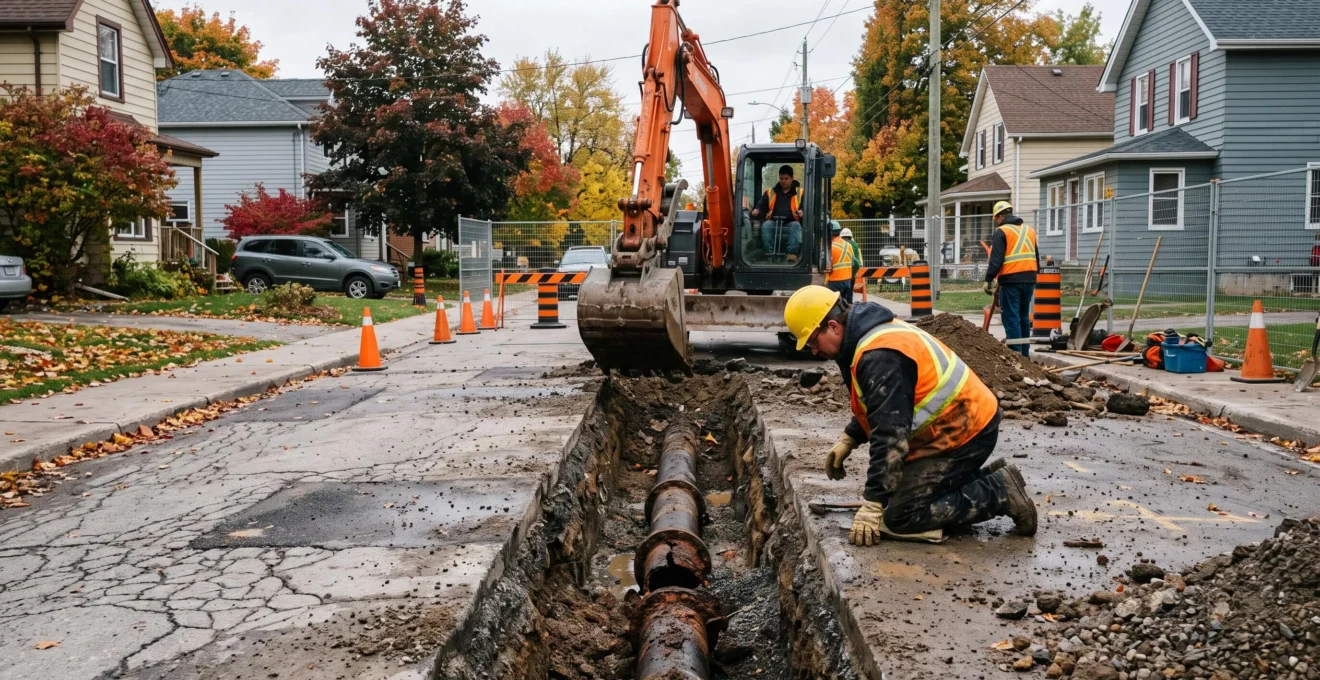
An aging water pipe, an already overcrowded school, or a neighborhood built without collective spaces may seem like distinct problems. Yet, these situations reflect a single challenge: making decisions today whose consequences will be felt for several decades.
In Canada, preparing communities for the needs of future generations requires better coordinating land use planning, public investments, and demographic and climate shifts. The issue concerns more than just large cities. Rural municipalities must also balance maintaining existing infrastructure, evolving services, and their financial capacities.
A resilient community is not one that systematically builds more. It is one that maintains its facilities, anticipates multiple growth scenarios, involves diverse groups of citizens in decisions, and retains maneuvering room to adapt to unforeseen changes.
Sustainably preparing Canadian communities: the essentials
- Maintaining existing infrastructure and evaluating costs over its entire lifespan limits the risk of unforeseen expenses.
- Planning housing, schools, community facilities, and public networks together helps avoid imbalances linked to growth.
- Diversifying citizen participation and comparing projects based on transparent criteria helps make fairer decisions.
- Why does postponing infrastructure maintenance increase future costs?
- How to involve teenagers in their municipality’s planning decisions?
- Library or sports facility: How to evaluate a neighborhood’s needs?
- What problems arise when a neighborhood grows without new schools?
- When should a municipality revise its growth forecasts?
- How to consult citizens without limiting participation in public meetings?
- Why do intense rains cause more runoff in cities?
- How to define collective priorities when the municipal budget is limited?
Why does postponing infrastructure maintenance increase future costs?
Postponing infrastructure maintenance may reduce municipal expenses in the short term but increase future costs when deterioration requires larger interventions. Pavement that could have been repaired may need to be reconstructed, while an aging pipe can cause a rupture. The challenge is to intervene before damages become disproportionate.
Infrastructure does not necessarily degrade at a constant rate. Depending on materials, usage, and environment, certain assets experience accelerated deterioration after a relatively stable operating period. This evolution can make preventive work significantly more advantageous than late replacement, without the same curve applying to all equipment.
Two forms of maintenance deficit must also be distinguished. The visible deficit includes cracked pavement, damaged sidewalks, and degraded public buildings. The invisible deficit notably concerns buried pipes, drains, and certain structures whose condition cannot be assessed from the street.
$294.4 billion CAD
Estimated rehabilitation or replacement needs for essential Canadian public infrastructure at the end of 2022 to maintain or restore them to good condition. This estimate covers several categories of public owners, not just municipalities.
Statistics Canada, survey on public infrastructure renewal needs, published in June 2025.
The same survey indicates that investment in the renewal of existing infrastructure $31.3 billion was invested in 2022. These two amounts should not be directly equated with a municipal budget deficit: they describe different realities and do not determine the needs of any particular city.
To establish priorities, a municipality must examine its asset inventory, their condition, criticality, and life-cycle costs. An asset management plan combined with multi-year capital budgeting helps distinguish urgent repairs from investments that can be staggered.
An emergency intervention can also entail indirect costs: traffic disruptions, service interruptions, interventions under difficult conditions, and team reorganization. Their importance varies according to circumstances and cannot be deduced from a universal coefficient.
This prevention logic also applies to collective facilities. However, their future utility depends on municipalities’ ability to understand the needs of residents who do not yet participate in decisions.
How to involve teenagers in their municipality’s planning decisions?
Municipalities can involve teenagers in planning by creating youth councils, advisory committees, and adapted participatory budgets. For this participation to be useful, young people must know which decisions they can influence, have resources to propose projects, and receive a response explaining what was retained.
Teenagers daily use parks, libraries, sports fields, and active transportation networks. Their experience can reveal problems barely visible in traditional consultations: dangerous crossings, lack of gathering spaces, insufficient access to activities, or inadequate transit schedules.
Several forms of participation can be envisioned:
- Municipal youth council: formulates proposals and can be consulted on local policies, according to an established mandate.
- Planning committee: examines a specific project, such as transforming a park or securing a school route.
- Youth participatory budget: allows proposing and potentially selecting projects funded by a determined envelope.
- School workshops: gather experiences from teenagers who would not spontaneously participate in a municipal meeting.
The essential difference lies in the power genuinely granted. A consultation allows expressing an opinion but does not guarantee it will be followed. A decision-making mechanism can offer a budget, a formalized right of proposal, or voting participation, subject to applicable rules.
However, the existence of a financial envelope is not enough. Ideas must join usual procedures: feasibility analysis, work planning, annual budget, and, when necessary, fundraising. This integration prevents projects from disappearing when participants change or a municipal mandate ends.
Ad-hoc consultations organized during school hours present another limitation: teenagers can contribute to diagnosis without being associated with definitive choices. Regular exchanges, accompanied by accessible reports on channels they actually consult, reinforce continuity.
Youth contribution becomes particularly relevant when determining which collective facilities meet a neighborhood’s present and future uses.
Library or sports facility: How to evaluate a neighborhood’s needs?
To choose between a library and a sports facility, a municipality must evaluate a neighborhood’s actual needs rather than comparing expressed demands alone. Determining criteria include existing facility accessibility, attendance, demographic trends, territorial inequalities, and operating costs. A multi-purpose solution can sometimes meet multiple needs.
A neighborhood with numerous families does not necessarily need a new gymnasium if school facilities are accessible outside class hours. Conversely, a heavily frequented central library may remain insufficient for residents in a peripheral sector poorly served by public transit.
The distinction between expressed need and latent need is fundamental. Residents generally ask for facilities they know. Yet, analyzing travel patterns, program registration, or neighboring service use can reveal demand for multi-purpose spaces, study rooms, or community activities.
An analysis grid helps make trade-offs more explicit:
| Criterion | Library | Sports facility |
|---|---|---|
| Targeted uses | Reading, learning, digital access, community activities | Physical activity, leisure, training, and gatherings |
| Accessibility | Distance, public transit, schedules, and universal accessibility | Distance, bookings, schedules, and universal accessibility |
| Demand to measure | Attendance, used services, unmet needs | Registrations, facility occupancy, waitlists |
| Recurring costs | Staff, collections, maintenance, energy | Staff, maintenance, energy, equipment renewal |
| Territorial equity | Access for currently underserved groups | Access for currently underserved groups |
Comparison must not stop at construction costs. Operating expenses, renovations, and future staffing needs can considerably alter the decision.
A hybrid solution also deserves study. A building could combine a library, community rooms, and activity spaces. School facilities could be shared with local associations when access, safety, and management rules allow.
Finally, territorial equity implies looking beyond the number of signatures gathered in a petition. A neighborhood whose residents rarely participate in consultations may present a larger facility deficit than a sector where citizen groups are highly organized.
This method must also anticipate new inhabitants. The rapid arrival of families can transform service needs, particularly regarding education.
What problems_survive_when_a_neighborhood_grows_without_new_schools?
When a residential neighborhood develops without sufficient school capacity, children may have to attend more distant institutions, while existing schools face increased pressure. Temporary premises, more motorized travel, and organizational difficulties can appear. These consequences show why school planning must accompany housing construction.
Residential growth and school enrollment growth do not always follow the same schedule. Initial housing units can be occupied before final classroom needs are known or facility projects have obtained authorizations and funding.
Difficulty also stems from shared responsibilities. In Canada, municipalities intervene in land use planning, but school planning and administration fall under educational authorities whose organization varies by province, notably school boards in Ontario and school service centers or competent bodies in Quebec.
Without sufficient coordination, several problems can accumulate: assignments to distant schools, use of temporary portables, congestion during bus and car arrivals, and decreased opportunity to walk or bicycle to school.
The problem concerns more than just the number of available rooms. Transport networks, intersections, sidewalks, and public spaces around institutions must also support new travel patterns.
In April 2026, the Government of Ontario published a regulatory proposal aimed at simplifying public school development approvals. This initiative illustrates the importance given to coordination between planning and school construction. However, the consultation notice alone does not allow concluding that proposed changes have been adopted.
Several planning measures can reduce risks:
- Provide potential school locations dès the design of major residential projects, in coordination with educational authorities.
- Update enrollment projections based on actually authorized and occupied housing.
- Examine the possibility of expandable school buildings when future needs remain uncertain.
- Study sharing sports, cultural, or community facilities with the municipality.
These solutions do not guarantee a school will be built: land availability, approvals, and funding decisions remain decisive. It would also be inaccurate to assume that a lack of spaces automatically triggers residential construction quotas in all provinces.
Such coordination nevertheless depends on regularly reassessed demographic projections. A reasonable forecast today may become insufficient after a major shift in the housing market or planning policies.
When should a municipality revise its growth forecasts?
A municipality should revise its growth forecasts when observed data durably diverge from its assumptions or when a major event modifies local prospects. Increased building permits, a new transit corridor, the arrival of a major employer, or demographic shifts can justify an update before the next planned review.
Forecasts serve to size water networks, roads, parks, and collective facilities. Their relevance thus depends as much on expected total population as on household composition and territorial distribution.
A city may experience moderate population growth but a sharp increase in household count, notably if average household size decreases. Conversely, a new family housing neighborhood can rapidly shift school needs without immediately modifying the municipality’s overall population.
It is useful to distinguish two revision modes:
- Periodic revision: updates organized according to planning cycles and obligations provided by applicable provincial frameworks.
- Triggered revision: anticipated analysis following a significant gap or an event likely to modify assumptions.
Regulatory cycles are not uniform across Canada. In particular, asset management plan deadlines must not be confused with those of urban planning documents.
To detect changes, several indicators can be tracked jointly: residential permits, completed and occupied housing, school enrollments, community facility usage, network capacity, and housing demand trends.
Relying on multiple growth scenarios avoids treating a single projection as certainty. A low scenario, a central scenario, and a high scenario can help distinguish essential investments from projects that can be phased.
Overestimating future population risks creating oversized facilities whose maintenance will weigh durably on the budget. Underestimating it exposes communities to saturated services and extra work. The challenge is planning adaptable capacities rather than seeking a perfectly exact forecast.
Quantitative indicators nevertheless remain incomplete without knowledge of lived needs. Citizen participation must help detect difficulties that aggregated statistics might mask.
How to consult citizens without limiting participation in public meetings?
To consult more citizens, a municipality must combine multiple participation modes rather than depending solely on public meetings. Accessible questionnaires, digital consultations, neighborhood kiosks, and targeted gatherings help gather different experiences. The quality of the process then relies on analyzing contributions and explaining decisions made.
An assembly organized in the evening does not suit all residents. Shift workers, parents of young children, certain persons with disabilities, and inhabitants living far from the meeting location can encounter significant obstacles.
Low attendance at a meeting does not necessarily mean a topic sparks little interest. It may reflect constraints of the proposed format.
Complementary modalities each present advantages and limits:
- Online consultations: offer more flexibility but can exclude individuals with digital access difficulties.
- Kiosks in libraries and community centers: reach residents already present in those locations without automatically representing the entire neighborhood.
- Small group gatherings: facilitate in-depth discussion but require more organization.
- Short questionnaires: allow gathering targeted responses with a risk of excessive simplification.
- Exchanges with community organizations: grant access to often overlooked experiences, without those organizations necessarily representing all concerned individuals.
The next difficulty consists in interpreting results. Summing responses across all channels can produce a misleading impression of representativeness, notably when the most mobilized participants use multiple channels.
A rigorous process compares contributions across neighborhoods, demographic profiles, and participation methods while flagging insufficiently represented groups. Qualitative comments can inform decisions without being equated with a representative poll.
Finally, publishing received proposals is not enough. A municipality should explain which ones were retained, modified, or discarded, as well as technical and financial constraints motivating those choices.
This approach is particularly important for environmental decisions, whose consequences can vary strongly from one neighborhood to another.
Why do intense rains cause more runoff in cities?
Intense rains cause more runoff in cities because impermeable surfaces limit water infiltration into soil. Roofs, roads, and parking lots quickly direct precipitation toward streets and drainage networks. When volumes or flows exceed capacity, water accumulations and floods can occur.
In a natural setting, part of rain is intercepted by vegetation, infiltrated into soil, or temporarily retained. In urbanized environments, water often circulates more quickly toward low points, particularly when impermeable surfaces are connected to drainage systems.
Infrastructure capacity depends on assumptions used during design, condition, and maintenance. Some older installations may be ill-suited to current extreme rains, but it would be inaccurate to claim all municipal networks were sized according to now-outdated standards.
Two network types must be distinguished. Storm sewers serve to evacuate rainwater, whereas sanitary sewers transport wastewater. In certain older sectors, combined sewers collect both. During heavy precipitation, their surcharge can cause overflows containing wastewater.
Green infrastructure can complement conventional networks. Rain gardens, vegetated bioswales, permeable pavements, and green roofs aim to slow, retain, or infiltrate part of precipitation.
Their effectiveness however depends on soil nature, available space, hydraulic design, winter conditions, and maintenance. An isolated rain garden cannot replace a municipal stormwater management strategy on its own.
Responsibilities are also shared. Municipalities control part of streets and public spaces, while private owners manage numerous parking lots, roofs, and lands likely to influence runoff.
A local policy can thus combine street planning, impermeable surface management, adapted incentive measures, and owner education on water damage risks and insurance conditions.
Necessary investments nevertheless compete with other municipal priorities. Selecting them requires an arbitration method accounting for immediate risks and costs passed on to future generations.
Key takeaways before choosing municipal priorities
- Compare projects based on their total cost over several years, not initial investment alone.
- Identify unavoidable obligations before debating expenses on which the municipality genuinely has a choice.
- Make trade-offs visible between safety, service access, inter-neighborhood equity, and future financial capacity.
How to define collective priorities when the municipal budget is limited?
When the municipal budget is limited, collective priorities must be defined by distinguishing mandatory expenses from genuinely negotiable projects. Investments can then be compared based on urgency, life-cycle cost, number of people concerned, territorial equity, and contribution to long-term objectives.
The first task consists of identifying budgetary constraints. A municipality must fund responsibilities framed by provincial laws, respect contractual commitments, and manage debt. Remaining leeway depends notably on revenues, reserves, obligations, and authorized financing options.
Citizen participation becomes more constructive when this leeway is presented clearly. Asking residents to choose among projects without specifying incompressibles expenses risks creating expectations incompatible with financial reality.
Participatory budgeting constitutes a potential tool for deciding how to use a determined funding envelope. In Montreal, the operation of participatory budgeting allows citizens to propose ideas that are subsequently examined and transformed into feasible projects prior to a vote. Selected projects are carried out within the limits of the planned budget.
This formula makes certain trade-offs accessible to the public without transferring all budget decisions to participants. It is particularly suited to projects eligible for the funding envelope, but does not replace the management of water networks, debt, or regulatory obligations.
To rank investments, a municipality can use a common grid:
| Criterion | Question to examine | Verifiable element |
|---|---|---|
| Safety and obligations | Does the project address a significant risk or applicable requirement? | Documented risk assessment and constraints |
| Life-cycle cost | What expenses will follow construction or repair? | Investment, operation, and renewal estimates |
| Affected population | Which residents will directly or indirectly benefit from the project? | Served population and expected uses |
| Territorial equity | Does the project reduce inequality in service access? | Comparison across neighborhoods |
| Complementary benefits | Does it contribute to multiple municipal objectives? | Expected effects on mobility, climate, or services |
Such a grid does not automatically produce the right decision. Criteria must be weighted publicly, and projects subject to unavoidable obligations should not be placed in competition with discretionary expenditures as if they held the same status.
Five actions to prepare a transparent municipal arbitration
- Inventory contemplated projects: produce a list including their objective, responsible department, and progress status.
- Identify constraints: establish a table distinguishing regulatory obligations, financial commitments, and discretionary projects.
- Evaluate future expenses: prepare a sheet per project indicating planned investments, estimated recurring costs, and main uncertainties.
- Compare benefits: complete a common grid on safety, concerned users, territorial equity, and environmental effects.
- Document the decision: publish a priority table detailing retained, postponed, or discarded projects and the reasons for each trade-off.
Arbitrations must also make the consequences of a postponement visible. Forgoing an increase in municipal revenues or borrowing can preserve immediate financial capacity, but does not make needs disappear. These can reappear in the form of deferred maintenance, reduced services, or more costly investments.
Conversely, multiplying facilities without planning for their operation can impose disproportionate burdens on future residents. Sustainability thus requires comparing the collective value of services with the resources needed to maintain them.
The next concrete step consists of examining the municipal budget, capital works program, and available asset management documents, then asking which growth assumptions, risks, and future costs justify the proposed priorities. A sustainable decision is one whose consequences remain understandable and debatable by the generations that will inherit them.
What documents should be consulted to learn about planned investments in one’s municipality?
The annual budget, multi-year capital program, planning documents, and asset management plans constitute useful starting points. Their naming and availability vary by province and municipality. They allow verifying announced projects, identified needs, and financial assumptions used.
Do small municipalities need to plan as far ahead as large cities?
Yes, to an extent adapted to their resources and obligations. Small municipalities can be particularly sensitive to replacement costs for a road, water pipe, or community building. Planning proportional to their means helps spread out expenses and examine collaboration opportunities between communities.
How to avoid building facilities that will be underutilized?
One must compare multiple demographic scenarios, examine the use of existing installations, and integrate operating costs from the initial evaluation. Scalable projects, multi-purpose buildings, and space sharing can offer greater flexibility when future needs remain uncertain.
Does a citizen consultation obligate a municipality to follow the majority opinion?
Not necessarily. Legal and decision-making scope depends on the mechanism, provincial rules, and announced mandate. A consultation generally gathers contributions meant to inform a decision. Certain participatory mechanisms grant more direct choice power within a defined framework. In all cases, explaining how opinions were considered improves transparency.
How to verify if a municipal decision genuinely protects future generations?
One must examine its long-term effects: maintenance costs, adaptability, climate risks, demographic trends, and equitable service access. A short-term favorable decision is not necessarily sustainable if it creates financial or environmental obligations that are difficult to bear. Monitoring indicators and regular reviews allow evaluating effects over time.