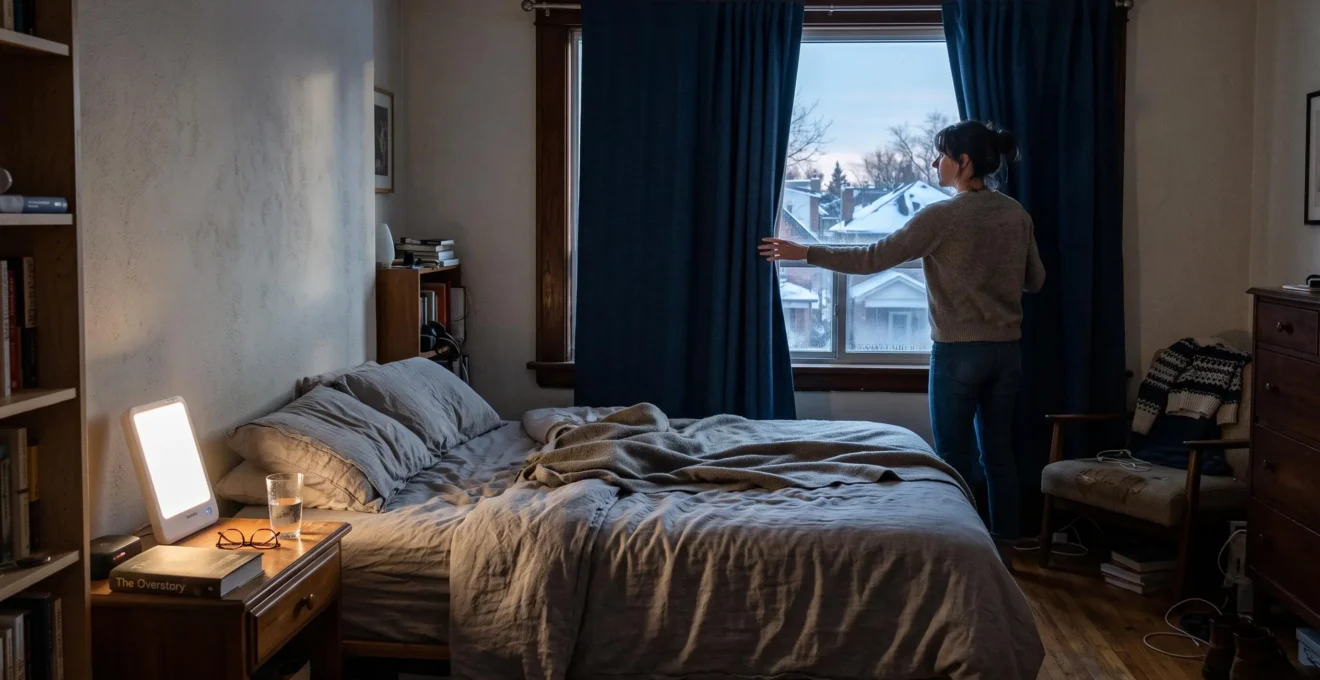
In Canada, long winter nights profoundly alter the environment in which daily routines unfold. The sun sometimes rises after the workday has already begun and sets before the commute home. Indoors, heating runs for months, windows often remain closed, and evenings stretch out in front of screens. These changes can disrupt sleep habits, even when bedtimes appear to remain unchanged.
To restore a more regular rhythm, it is helpful to act simultaneously on several factors: light exposure, bedroom temperature, humidity, noise disturbances, and end-of-day rituals. Transforming your entire home is not necessary. A few adjustments, tailored to the constraints of a Canadian apartment and a professional schedule, can create more favorable conditions for rest.
The goal is to establish stable anchors between periods of activity and rest, without imposing the exact same rhythm on everyone.
Essentials for sleeping better during the Canadian winter
- Seek daylight at regular times, particularly after waking up or during lunchtime breaks.
- Maintain a bedroom that is relatively cool, quiet, and comfortable, while monitoring humidity and ventilation.
- Stabilize wake-up times and establish a calming transition between work, screens, and bedtime.
- Why can short days disrupt sleep schedules?
- How to get more daylight when working indoors?
- Cool or highly heated bedroom: which environment promotes sleep?
- Why can evening screen exposure delay falling asleep?
- When should you start adjusting sleep hours after a schedule change?
- What problems does overly dry air cause in a heated bedroom during winter?
- How to create a calming transition after an intense workday?
- How to set up a peaceful rest area in a noisy apartment?
Why can short days disrupt sleep schedules?
Short days sometimes disrupt sleep because natural light helps synchronize the biological clock. When morning light exposure decreases and artificial lighting extends into the evening, the signals distinguishing wakefulness from rest become less distinct. Falling asleep and daytime alertness can then shift out of sync.
The circadian clock regulates periods of alertness, body temperature, and the secretion of melatonin, a hormone associated with preparing for sleep. The light received at specific times of the day influences this mechanism. In particular, sufficiently bright light after waking up can help reinforce the wakefulness signal, whereas strong light exposure in the evening can delay the internal clock.
These principles are explained in the recommendations from NIOSH on light and circadian rhythms. They emphasize that the effect of light also depends on when it is received.
In several Canadian regions, particularly at high latitudes, daylight duration decreases sharply in December. A person starting their day early may leave home in the dark and finish work after sunset. Natural light exposure then becomes limited, especially when working in a room far from windows.
However, a distinction must be made between a disrupted sleep-wake rhythm and true sleep debt. Sleeping long enough does not always guarantee feeling rested, but persistent fatigue should not automatically be attributed to a lack of sunshine. Sleep quality, stress, irregular schedules, or health conditions can also play a role.
An observation exercise consists of tracking the following for seven days:
- Wake-up time and bedtime.
- Approximate time taken to fall asleep.
- Periods spent outdoors in daylight.
- Drowsiness experienced during the day.
This log does not constitute a diagnosis. It simply helps identify potential associations between days spent indoors and difficulties falling asleep.
Once this mechanism is observed, the next step involves deliberately organizing access to natural light, even when professional constraints seem to offer few opportunities.
How to get more daylight when working indoors?
To make better use of winter light, reserve specific times for going outdoors and shift daily activities closer to windows. A walk during lunch break, a better-positioned desk, or a brief outing after waking up can strengthen light anchors. When natural exposure remains insufficient, light therapy can be considered with appropriate precautions.
The first instinct should be to identify periods when sunlight is actually present. In certain Canadian cities, going outside after work no longer provides daylight during a large portion of the winter. Lunch breaks thus become a particularly valuable opportunity.
Outdoor exposure and exposure behind a window are not equivalent. The brightness received varies depending on building orientation, weather conditions, glass glazing, and distance from the window. Working near a bay window remains helpful for benefiting from available natural light, but does not necessarily replace an outing outdoors.
A simple routine can be built around two complementary approaches:
| Situation | Action to prioritize | Limitation to consider |
|---|---|---|
| Working near a window | Place the desk in the area with the best natural light. | Indoor light may remain insufficient to act as a strong circadian signal. |
| Lunch break available | Plan a 15- to 30-minute outdoor walk, depending on conditions. | Winter conditions may require shortening or moving the walk. |
| Remote work without daily commute | Create a regular short walk before or during the day. | Consistency relies on deliberate planning. |
| Very limited natural exposure | Discuss the benefits of a light therapy lamp with a healthcare professional. | The device, its intensity, and timing of use must be tailored. |
For a remote worker, a walk can symbolically replace the usual morning commute. Even on overcast days, going outside offers a break from indoor lighting and establishes a clear landmark in the day. Snow-covered surfaces can enhance perceived brightness, but should never justify looking directly at the sun.
Light therapy is not a universal solution. Its use may require specific precautions in the presence of certain eye conditions, bipolar disorders, or photosensitizing treatments. Medical advice is recommended before beginning regular use in these situations.
Light helps stabilize biological rhythms, but the thermal environment takes over at bedtime: an overly warm room can compromise the intended comfort.
Cool or highly heated bedroom: which environment promotes sleep?
A relatively cool bedroom generally promotes sleep better than an overheated room, provided you stay comfortable under the covers. Falling asleep is accompanied by a drop in core body temperature. Excessive heat can make this transition less pleasant, while an overly cold room can cause awakenings or muscle tension.
In Canadian buildings, central or shared heating systems can maintain high temperatures even when occupants prefer to sleep in a cooler atmosphere. This issue frequently arises in apartments where the thermostat is shared or difficult to adjust.
The NIOSH module on the sleep environment recommends prioritizing a cool room with enough blankets to maintain thermal comfort. It also specifies that individual preferences vary. There is no single temperature that suits every sleeper.
Air temperature and the temperature felt under bedding are two distinct things. A person can sleep comfortably in a relatively cool room with suitable blankets. Conversely, a very thick duvet in an overheated room can intensify heat sensations.
When heating is difficult to control, several adjustments can be tried without major work:
- Reduce bedroom heating if the system allows individual adjustment.
- Layer relatively light bedding that can easily be removed during the night.
- Aerate briefly when outdoor conditions and home security permit.
- Avoid directing heat sources straight toward the bed.
- Observe sensations of heat, cold, and nighttime awakenings before modifying setups further.
Opening windows must remain compatible with weather conditions. During severe cold spells, leaving a window open overnight can excessively chill the room or compromise heating infrastructure safety. Heating units and their ventilation outlets should never be obstructed.
Upon waking, a very cold room can make getting up unpleasant. Preparing warm clothing and slippers nearby allows you to keep a room comfortable for sleep without turning getting out of bed into a daily ordeal.
Temperature, however, is only one factor among others. Even in a comfortable room, light and evening activities can delay sleep.
Why can evening screen exposure delay falling asleep?
Using screens in the evening can delay falling asleep by combining light exposure, mental stimulation, and prolonged activity. Light from devices can alter circadian signals, while engaging content maintains focus. Time spent watching a series, working, or checking social media can also directly postpone bedtime.
The phenomenon is not limited to blue light alone. A stressful work discussion, a stream of videos, or distressing news can prolong wakefulness even when screen brightness is reduced.
An experimental study by Chinoy and colleagues on tablets and sleep, referenced in PubMed, published in 2018, compared unrestricted light-emitting tablet use in the evening to print reading among nine healthy adults.
31 minutes
In this small study, participants chose to go to bed an average of about 31 minutes later on tablet evenings compared to paper-reading evenings. This experimental finding cannot predict screen effects across all adults.
Chinoy et al., Physiological Reports, 2018, experimental study with nine participants.
Researchers also observed shifts in certain circadian markers, notably melatonin secretion. However, this study does not prove that digital content is systematically more disruptive than light itself.
In the context of long Canadian winter evenings, screens easily become the dominant activity after dinner. A more realistic approach than a strict ban consists of gradually altering the final portion of the evening.
For example, someone accustomed to using their phone until bedtime can start by reserving the last 15 minutes for a quiet activity, then extend this period to 30 minutes if suitable. Possible activities include reading printed material, preparing next-day clothes, gentle stretching, or a warm shower followed by relaxation.
An evening structured around a meal, a manual or social activity, and a bedtime ritual also lowers the likelihood of consuming content uninterrupted until late hours. Muting non-essential notifications helps preserve this transition.
This strategy becomes even more effective when aligned with regular wake and sleep times, especially during seasonal time changes.
When should you start adjusting sleep hours after a schedule change?
It is preferable to start adjusting schedules a few days prior to a predictable change whenever possible. Gradually shifting bedtime and especially wake time helps reduce the disruption between the old rhythm and the new one. Light exposure must accompany this adjustment, as it directly participates in synchronizing the biological clock.
In Canada, the return to Standard Time in the fall is a frequent shift, but it does not affect every region in the same manner. Daylight saving rules vary by province, territory, and certain municipalities. A job change, shift work, or travel across time zones within the country can also impose a new schedule.
For moderate shifts, a practical method involves adjusting habitual times in increments of 15 to 30 minutes, then observing sleep response before making further shifts. This rate represents an adaptation strategy, not a guarantee of identical physiological adjustment for everyone.
Direction of the change should also be considered:
- To advance your schedule: gradually advance wake time, seek bright light after waking, and dim evening illumination.
- To delay your schedule: shift activities cautiously without artificially shortening total available sleep time.
- After travel: align periods of light and rest with the new local time, accounting for travel direction.
- During shift changes: factor in work obligations, commutes, and the realistic ability to maintain adequate sleep duration.
The transition to Standard Time in November does not necessarily require extensive preparation for everyone. Some adapt easily, while others experience several days of daytime drowsiness or difficulty maintaining habits.
In all cases, keeping a relatively stable wake-up time and preserving sufficient sleep time serve as valuable anchor points. If experiencing pronounced fatigue, avoid long road trips or high-risk tasks, particularly during challenging winter conditions.
Do not force sleep by spending extended periods awake in bed. A step-by-step adaptation, accompanied by light at appropriate times and calm evening activities, aligns better with natural sleep mechanisms.
Once schedules are stabilized, other housing characteristics can still trigger nighttime awakenings, notably overly dry air in a heated bedroom.
What problems does overly dry air cause in a heated bedroom during winter?
Very dry indoor air can cause mucosal discomfort, a dry throat sensation, chapped lips, and occasionally nasal irritation. For some people, these symptoms make nights less comfortable. However, humidity should be measured before using a humidifier, as excess moisture promotes condensation and mold growth.
During Canadian winters, cold outdoor air holds very little absolute moisture. When it enters a building and is heated without additional moisture input, its relative humidity drops. This mechanism explains the dryness sensations frequently reported during heating season.
Possible consequences include an uncomfortable throat upon waking, dry lips, nasal irritation, or thirst. However, these symptoms alone do not prove that dry air is responsible for fragmented sleep. Other causes, such as mouth breathing, allergies, or certain medications, may be involved.
The first step is to measure relative humidity using a hygrometer placed in the bedroom, rather than purchasing a humidifier right away.
30% to 50%
Relative indoor humidity range recommended by Health Canada to limit moisture-related issues in the home. This range has not been proven optimal for sleep specifically. In winter, some homes require lower humidity to prevent condensation on cold surfaces.
Recommendation from Health Canada’s guidance document on moisture and mold in homes.
If humidity is genuinely low and causes discomfort, a humidifier can be considered. It must be maintained according to manufacturer instructions, paying special attention to cleaning, water replacement, and preventing mineral buildup or contamination.
Methods such as drying laundry indoors or letting shower steam spread through the dwelling require caution. They can increase ambient humidity, but also exacerbate condensation when ventilation is inadequate. They do not automatically constitute suitable solutions.
The regular presence of persistent fogging on windows, damp surfaces, or traces of mold should prompt an inspection of ventilation and moisture sources before adding more humidity.
Check heated bedroom comfort in five actions
- Place a hygrometer in the bedroom and record an initial relative humidity measurement in a notebook.
- Record humidity at comparable times across several days to create a small tracking log.
- Inspect windows and cold walls, then compile a list of any condensation signs.
- Verify that accessible ventilation vents are unblocked and log any noted anomalies.
- Select an adjustment tailored to observations, then compare measurements and perceived comfort after a few days.
This systematic process prevents confusing perceived dryness with genuinely insufficient humidity. It also aids in understanding heating effects without unnecessarily increasing energy consumption or dampness risks.
A comfortable physical environment contributes to rest, but it remains necessary to gradually ease mental tension accumulated throughout the day.
How to create a calming transition after an intense workday?
A calming transition consists of clearly separating work obligations from evening activities. Wrapping up pending tasks, changing environments, and engaging in a quiet activity helps lower mental stimulation before bed. In winter, this transition is particularly valuable when work ends after nightfall or directly within a home office.
An intense day can leave a lingering sense of urgency: unread messages, pending decisions, upcoming meetings. Getting straight into bed after finishing work is not always enough to interrupt this mental activity.
This challenge is sometimes heightened by remote work. Without a commute between office and home, the two spaces blur together. The workspace can remain visible from the sofa, and the computer remains accessible throughout the evening.
A three-part transition can help re-establish separation:
- Wrap up the day: write down remaining tasks and select which ones will be picked up tomorrow to avoid keeping them mentally active.
- Shift states: close the computer, pack away work gear, change clothes, or take a short walk.
- Gradually reduce stimulation: prepare a meal, read, listen to calming audio content, or enjoy a simple manual activity.
Physical fatigue and cognitive fatigue do not always call for the same response. After a day spent on your feet, a quiet seated moment can be refreshing. After several hours of intellectual work, a light walk or simple screen-free activity offers a clearer break.
Routine consistency matters more than complexity. It can take just a few minutes on busy days and expand when schedules allow. The essential key is finding recognizable actions that mark the conclusion of work duties.
In winter, an outdoor walk must naturally account for weather, sidewalk conditions, and visibility. When going out is unfeasible, a gentle indoor activity can fulfill a similar transitional function without claiming to replace daylight exposure.
It is also useful to separate the work end time from bedtime itself. A short period of personal time prior to sleep preparation minimizes the risk of systematically associating bed with work concerns.
This transition becomes smoother when the living space features an identifiable rest area. In a noisy apartment, this requirement may demand a few extra adjustments.
Key takeaways before setting up your bedroom
- Identifying noise sources first makes it possible to choose a solution proportional to the actual problem.
- Reversible adjustments should generally be tested before committing to major expenses or renovations.
- Desired quietness must remain compatible with adequate ventilation, home safety, and thermal comfort.
How to set up a peaceful rest area in a noisy apartment?
To set up a rest area in a noisy apartment, first identify the sounds disturbing sleep, then target their transmission or perception. Moving the bed away from main noise sources, sealing noise pathways, and occasionally using earplugs or white noise can enhance comfort without heavy structural changes.
Noise disturbances do not all stem from the same source. Conversations heard through a wall, footsteps from an upper floor, heavy outdoor traffic, or running ventilation systems are not addressed in the same way.
Before modifying the layout, it is helpful to log the times, locations, and circumstances in which noises occur. This simple assessment makes it possible to distinguish occasional disturbances from recurring issues.
Once the source is identified, interventions can be organized by order of simplicity:
| Type of noise | Feasible measure | Main limitation |
|---|---|---|
| Outdoor traffic | Check window closures, install heavy curtains, and move the bed if possible. | Curtains primarily reduce certain acoustic reflections and do not replace an insulating window. |
| Neighbor conversations | Move the bed away from the shared wall and consider discreet background noise. | Sounds transmitted through walls may sometimes remain noticeable. |
| Impact noise | Use rugs to limit certain impacts generated within your own home. | A rug in your own apartment generally does not solve noise transmitted from the floor above. |
| Door or hallway noise | Check seals and the air gap under the door, without compromising required ventilation. | An opening necessary for air circulation must not be blocked without verification. |
| Heating, plumbing, or ventilation | Document noises and report anomalies to the property manager or landlord. | Remediation may require technical intervention. |
In smaller homes, moving the bed may simply consist of choosing the wall least exposed to noise. Earplugs can offer temporary assistance when comfortable and properly used. Moderate-volume white noise can also mask certain disturbances without eliminating their source.
For tenants, a distinction must be made between personal adjustments and issues involving building maintenance or operations. A particularly noisy ventilation system or defective equipment warrants reporting. When disturbances persist, keeping a record of incidents and reviewing the lease or building regulations can facilitate next steps.
Available recourse varies by Canadian province, territory, and sometimes municipality. No single national rule automatically determines what a landlord must undertake for every disturbance.
Finally, the pursuit of quiet should not result in inadequate bedroom ventilation. Closing windows can reduce street noise, but necessary ventilation pathways must be preserved while monitoring condensation. Aerating during quieter periods can be considered when conditions permit.
The next step involves choosing a single manageable change to implement this week: moving the bed, checking humidity, or addressing a specific identified noise. Observing nighttime comfort over several days will determine whether the adjustment should be maintained or expanded upon.
Do you need to sleep more in winter than in summer?
Not necessarily. Sleep needs vary mainly according to individual characteristics, health, and activity levels. Shorter days can alter the sensation of fatigue without automatically meaning total sleep time needs to increase. It is preferable to monitor schedule consistency, rest quality, and daytime alertness.
Can a light therapy lamp replace a walk in natural daylight?
A light therapy lamp can be helpful in specific situations, but it does not reproduce all the benefits of going outdoors. Its effectiveness depends on the device, light intensity, and timing of use. It should not be used without precautions in the presence of certain eye conditions, bipolar disorders, or photosensitizing treatments.
Is it better to keep curtains open overnight in winter?
It is generally preferable to limit disruptive light sources during sleep, then allow natural light in upon waking. In homes where curtains contribute to thermal insulation, their use must also account for cold air and condensation. Suitable artificial lighting at wake-up time can be considered when the sun rises late.
How can you tell if nighttime awakenings stem from housing conditions or a sleep disorder?
Observing awakening times, noises, room temperature, and bedroom conditions can highlight certain patterns. However, these observations alone cannot diagnose the underlying cause of sleep difficulties. If awakenings persist, are accompanied by significant daytime drowsiness, severe snoring, or observed breathing pauses, medical consultation is indicated.
Can winter sleep be improved without buying new equipment?
Yes. Several adjustments require no purchases: stabilizing wake-up times, taking advantage of available daylight, relocating a desk or bed, reducing evening screen time, and establishing an end-of-day wind-down routine. Additional equipment becomes relevant only after a specific need is identified and simpler solutions prove insufficient.